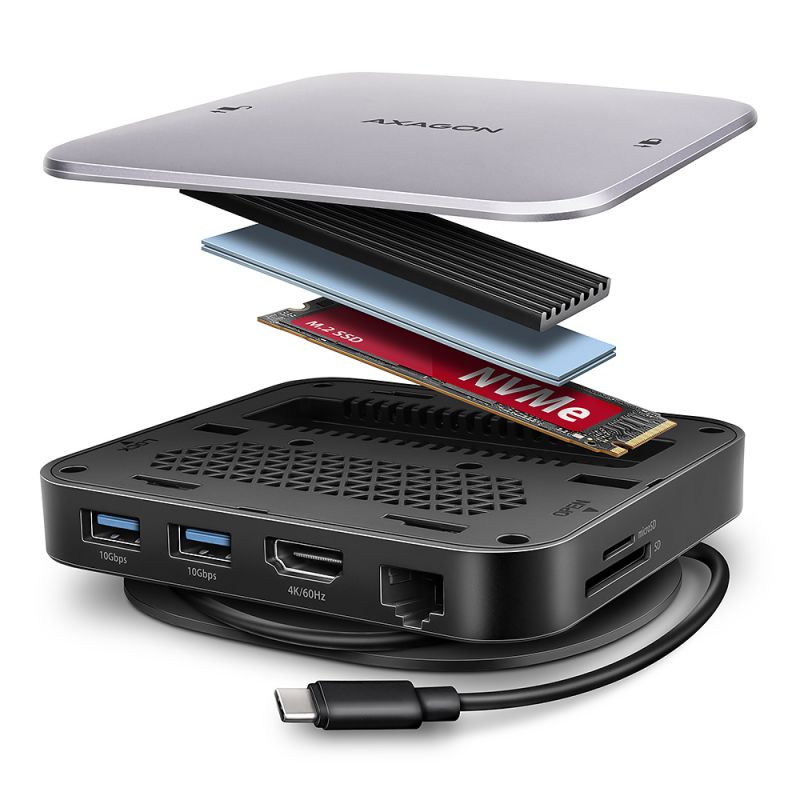
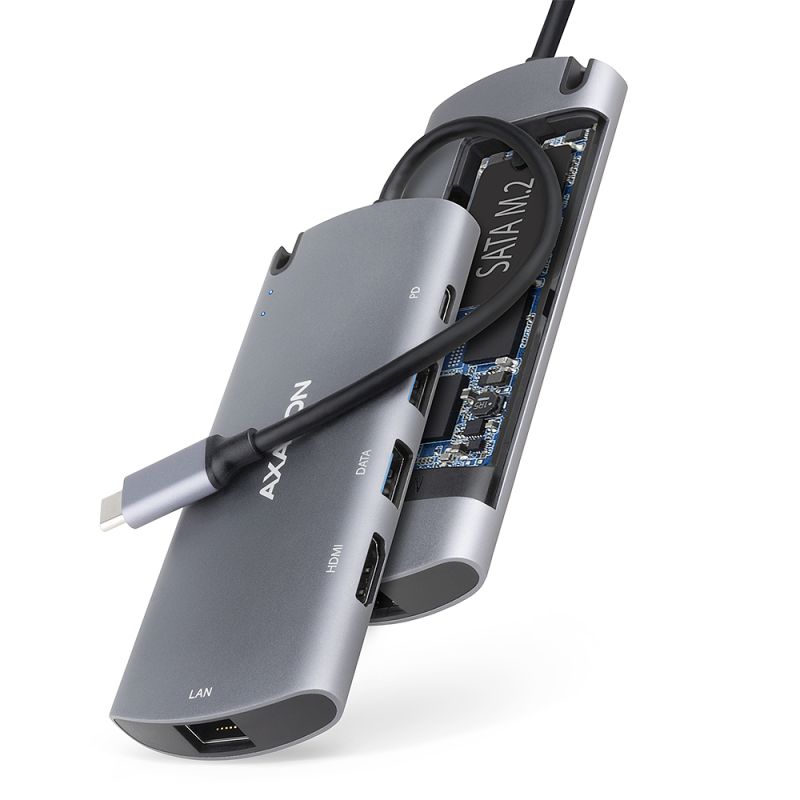
Référence produit: HMC-10HLS
Catégorie: Stations d'accueil , Un écran + Ethernet , Stations d'accueil polyvalentes , Tous les produits
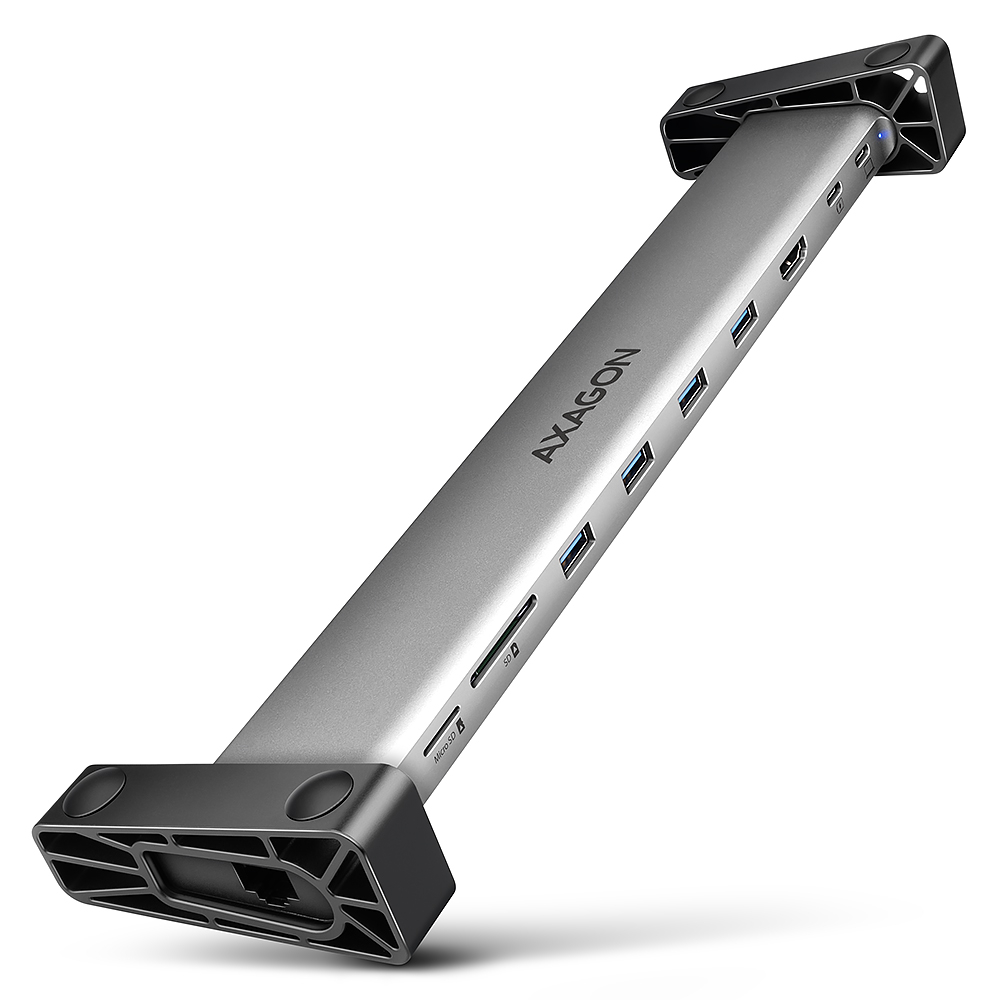
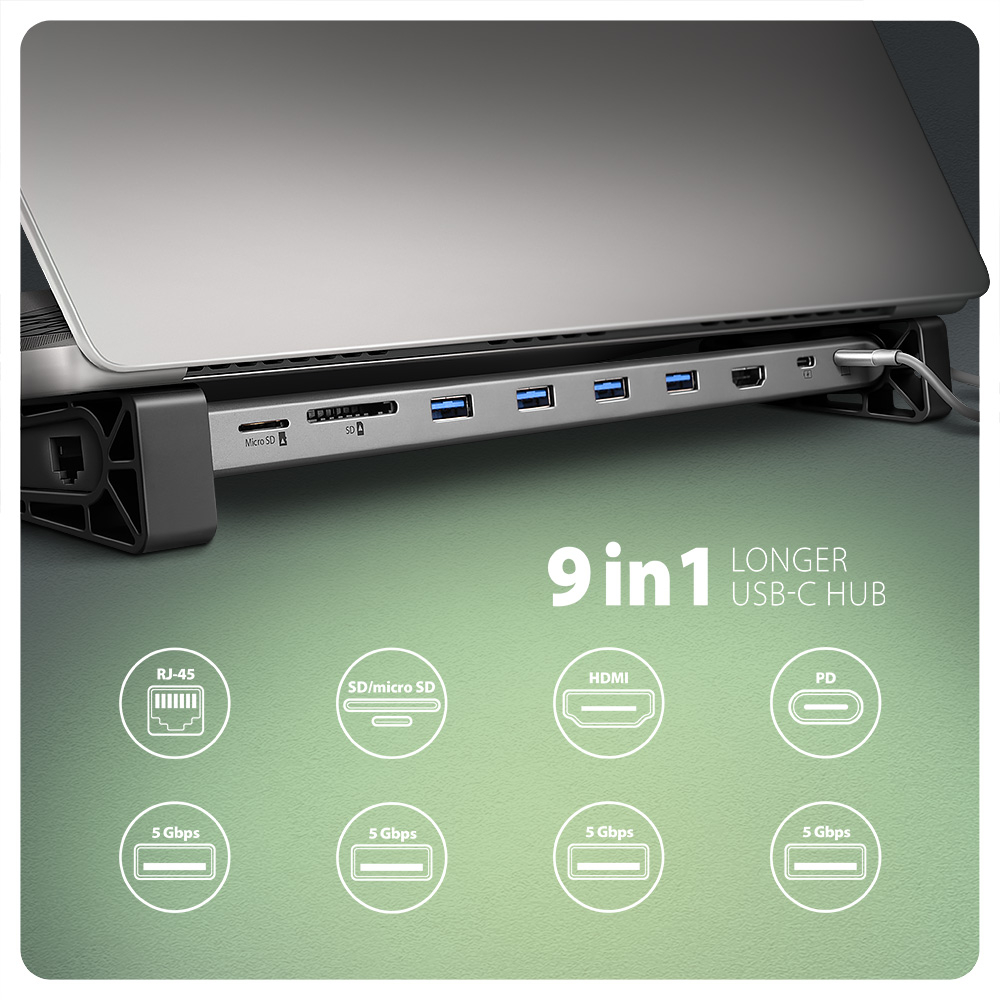
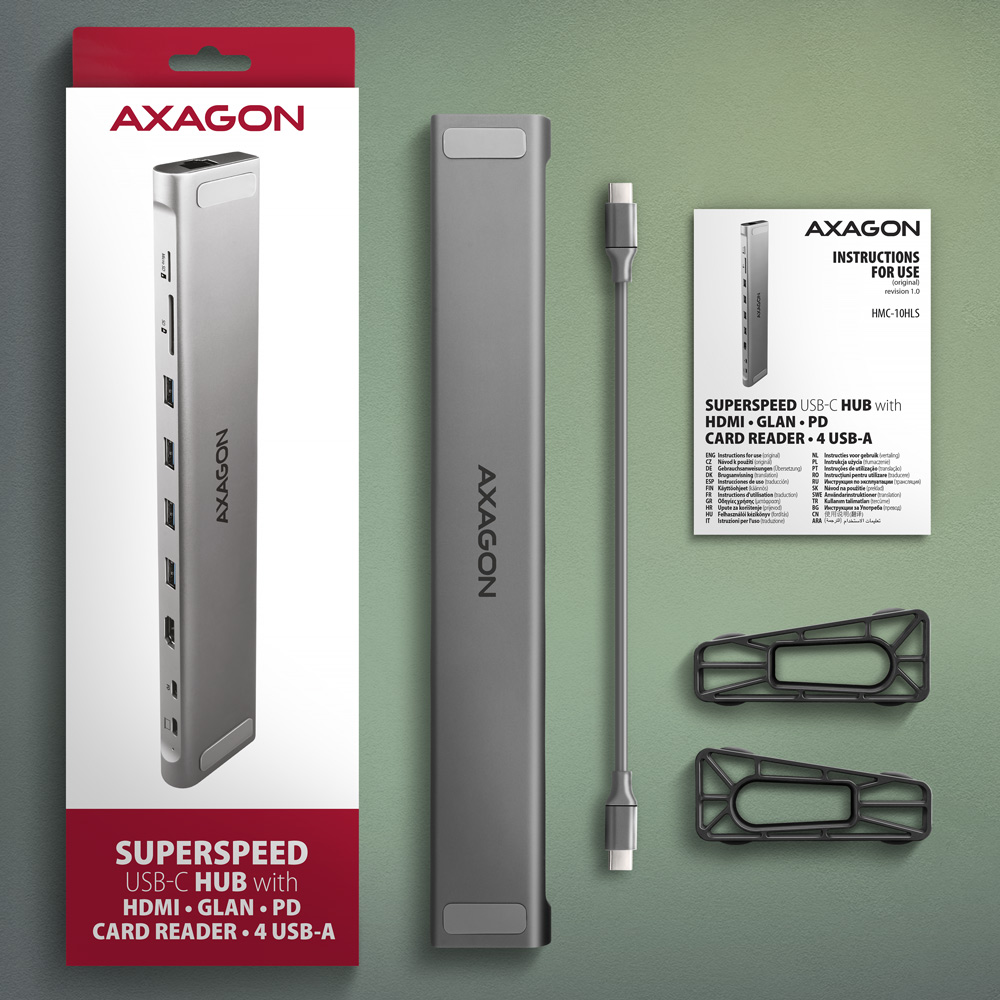
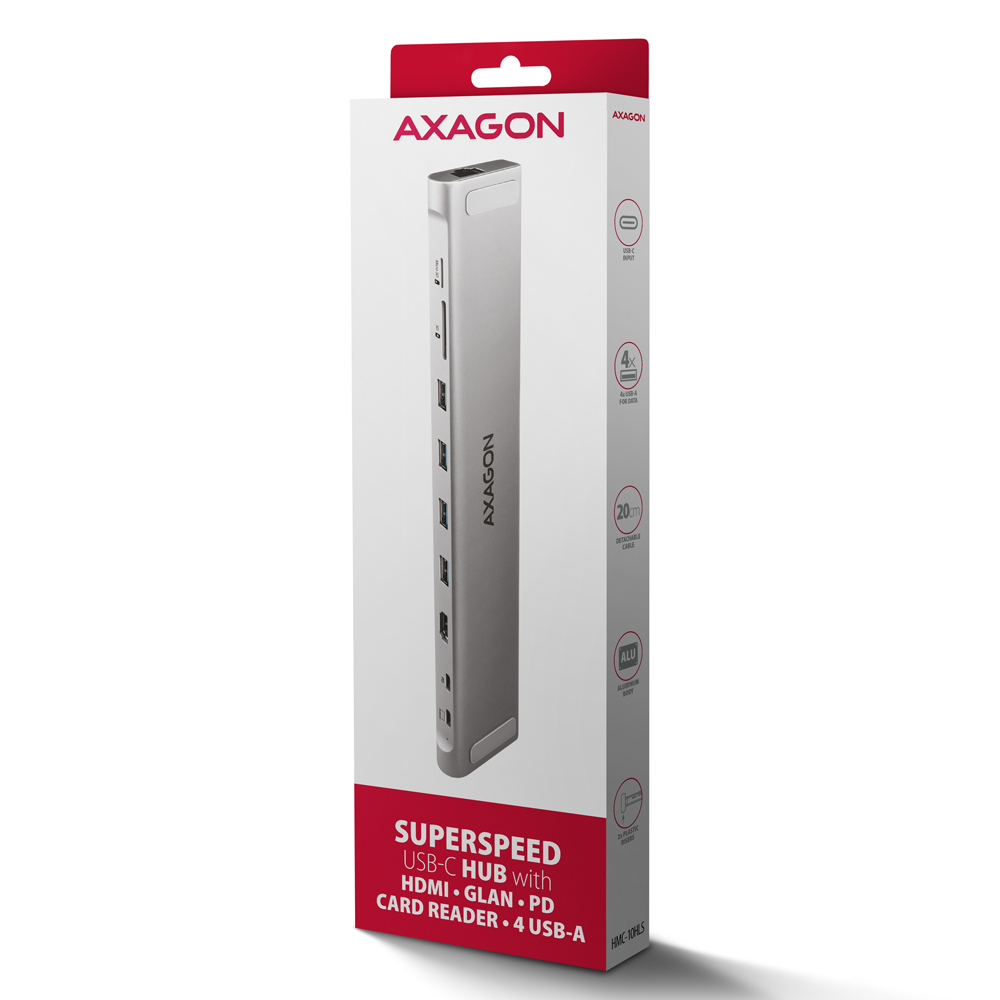
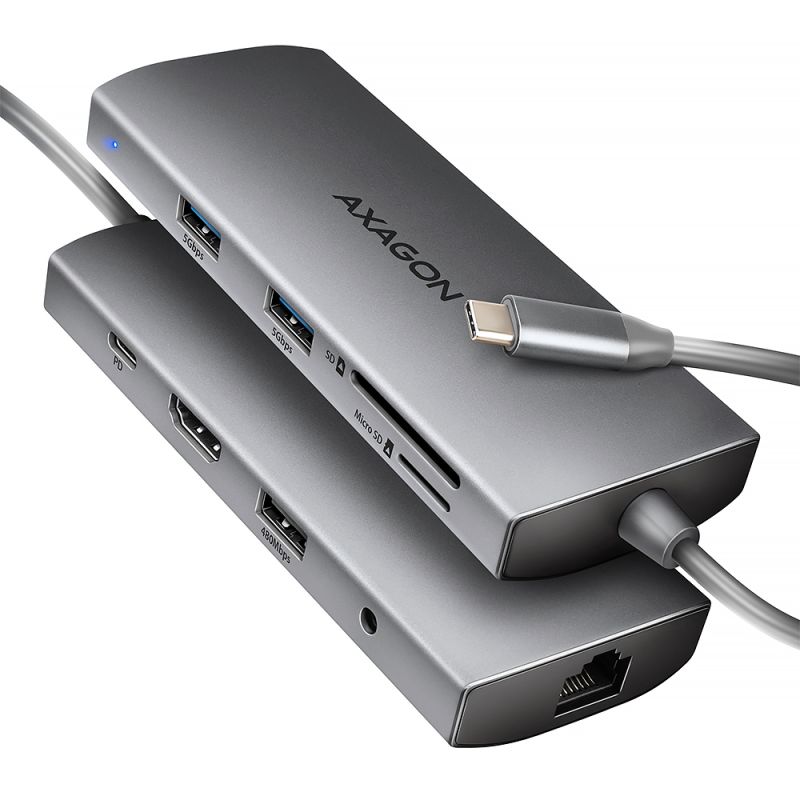
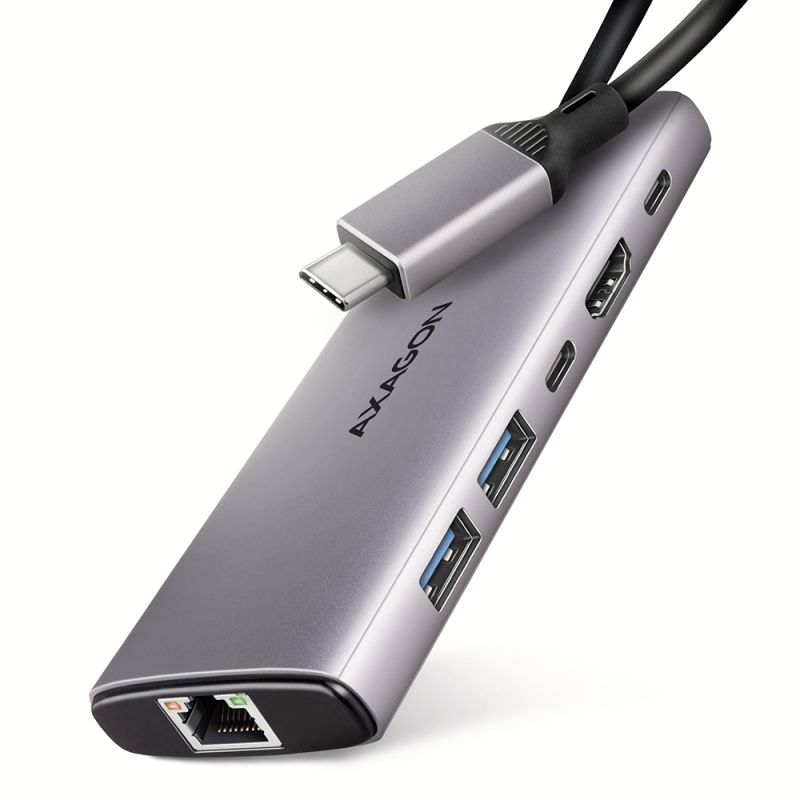
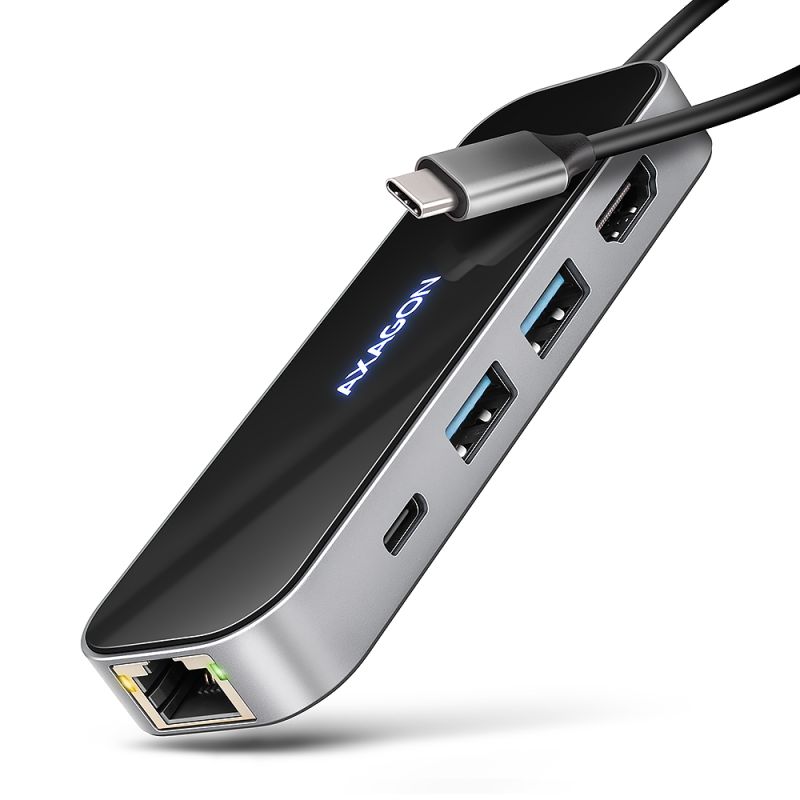
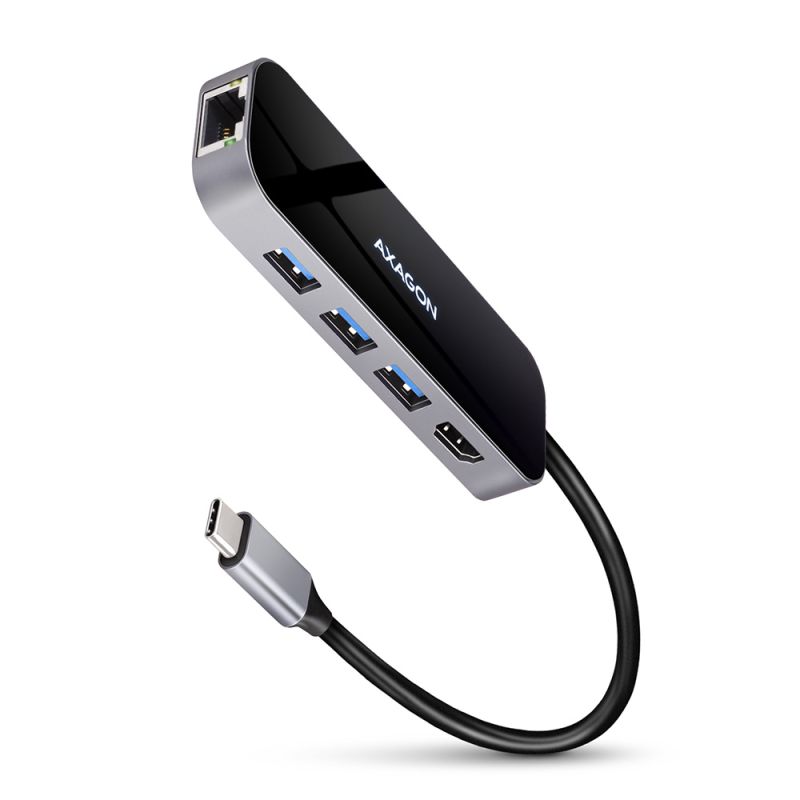
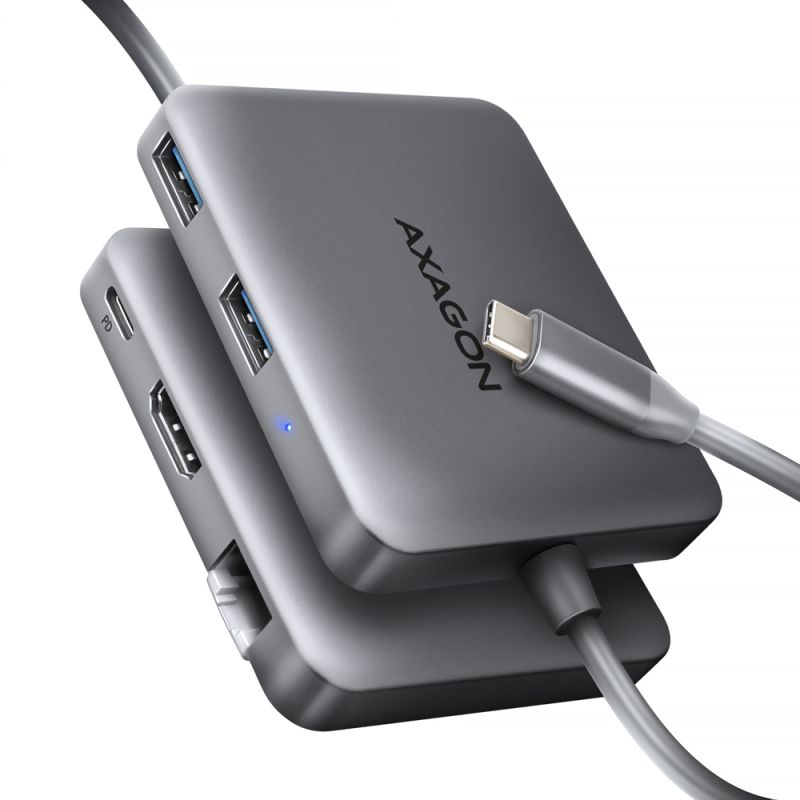
AXAGON HMC-10HLS LONGER hub multiport USB-C 5Gbps 9in1 étendra votre ordinateur portable, ordinateur de bureau ou téléphone avec neuf ports. Grâce au connecteur USB-C réversible, vous pouvez facilement et rapidement connecter un moniteur, quatre appareils USB, un réseau Ethernet Gigabit et un lecteur de cartes SD à votre ordinateur. Vous bénéficiez également de la possibilité d'alimenter l'ordinateur portable via la technologie Power Delivery. Ce réplicateur de ports vous offre ainsi une station d'accueil compacte 9-en-1 non seulement pour les ordinateurs portables Windows, mais aussi pour les MacBook d'Apple tels que le MacBook Air ou le MacBook Pro.
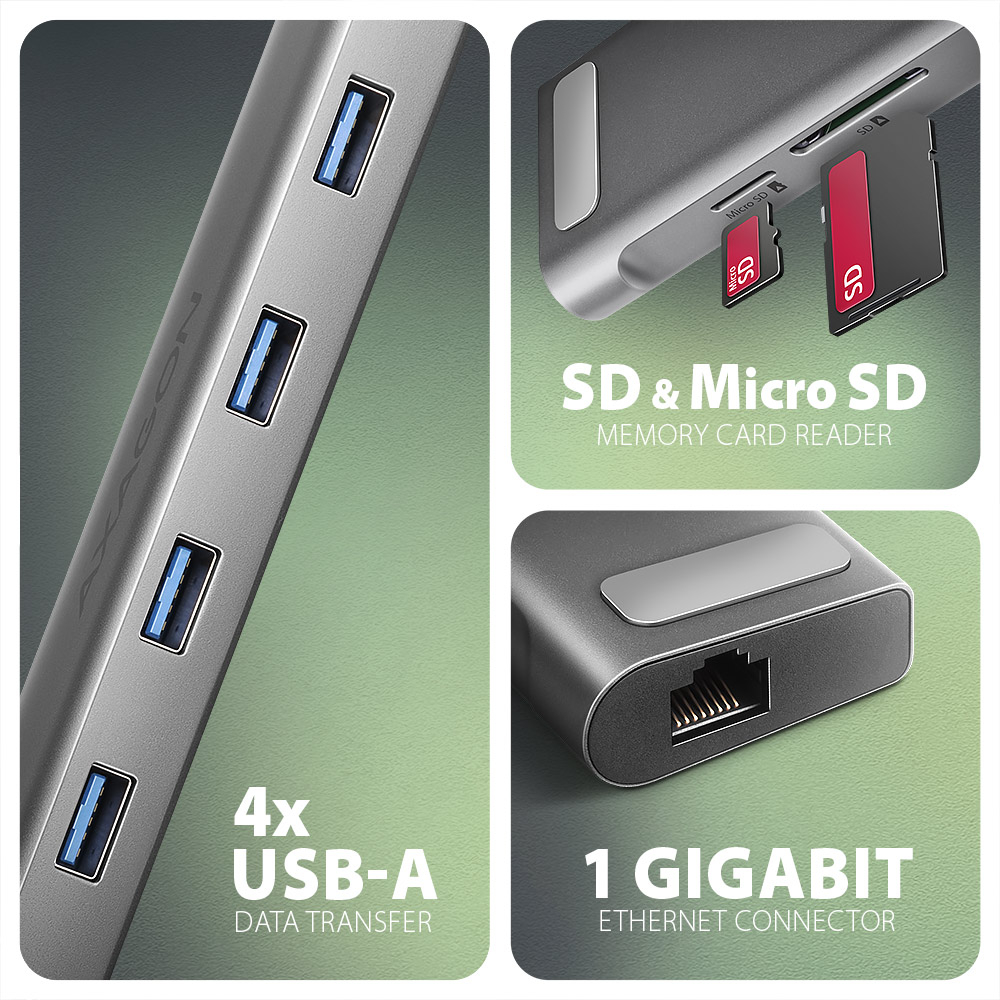
Le hub USB offre quatre sorties USB à une vitesse de 5Gbps avec un connecteur USB-A female standard. Le hub peut également prendre en charge la connexion permanente de jusqu'à trois disques externes simultanément. Grâce à l'interface USB 3.2 Gen 1 rapide, la vitesse de transfert du hub peut atteindre jusqu'à 5Gb/s. Le hub est également capable de charger les téléphones mobiles et les tablettes connectés aux ports USB du hub avec un courant jusqu'à 1.5A/5V. Vous pouvez ainsi facilement charger par exemple un smartphone Android, un Apple iPhone, un Apple iPad, etc.
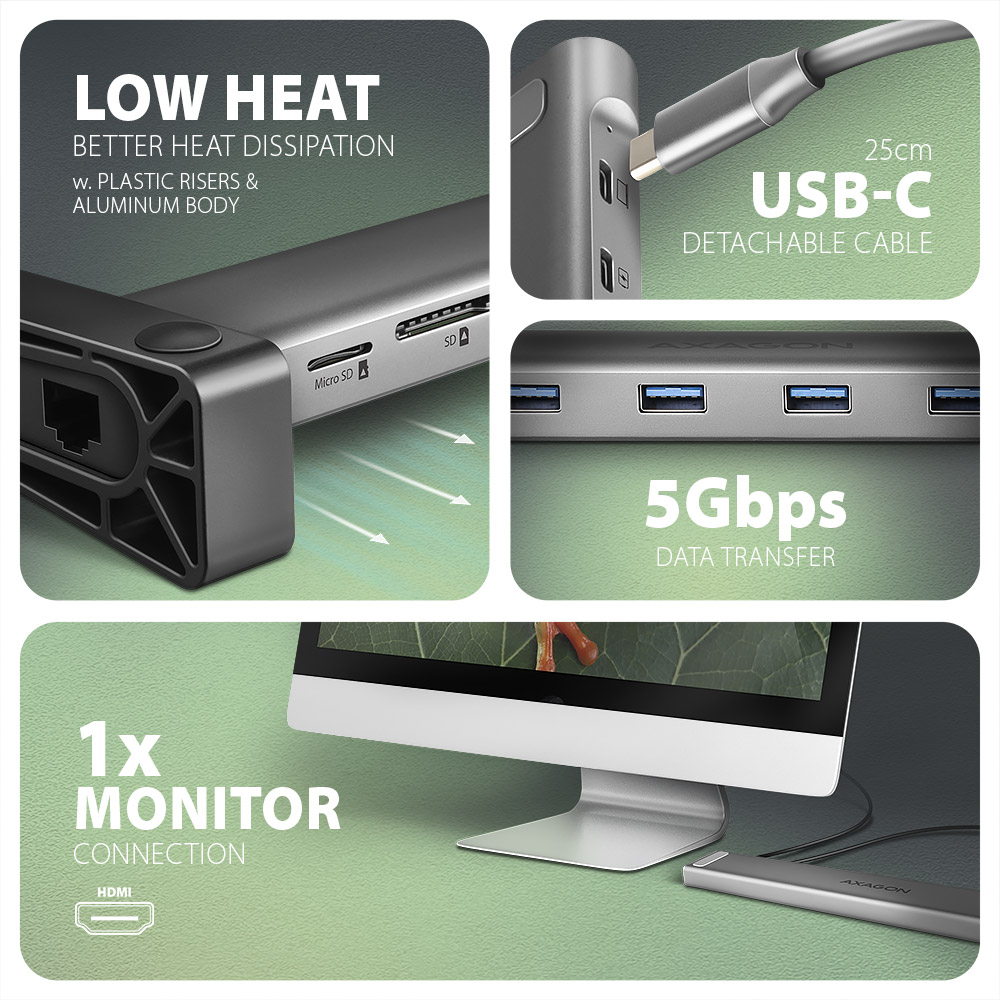
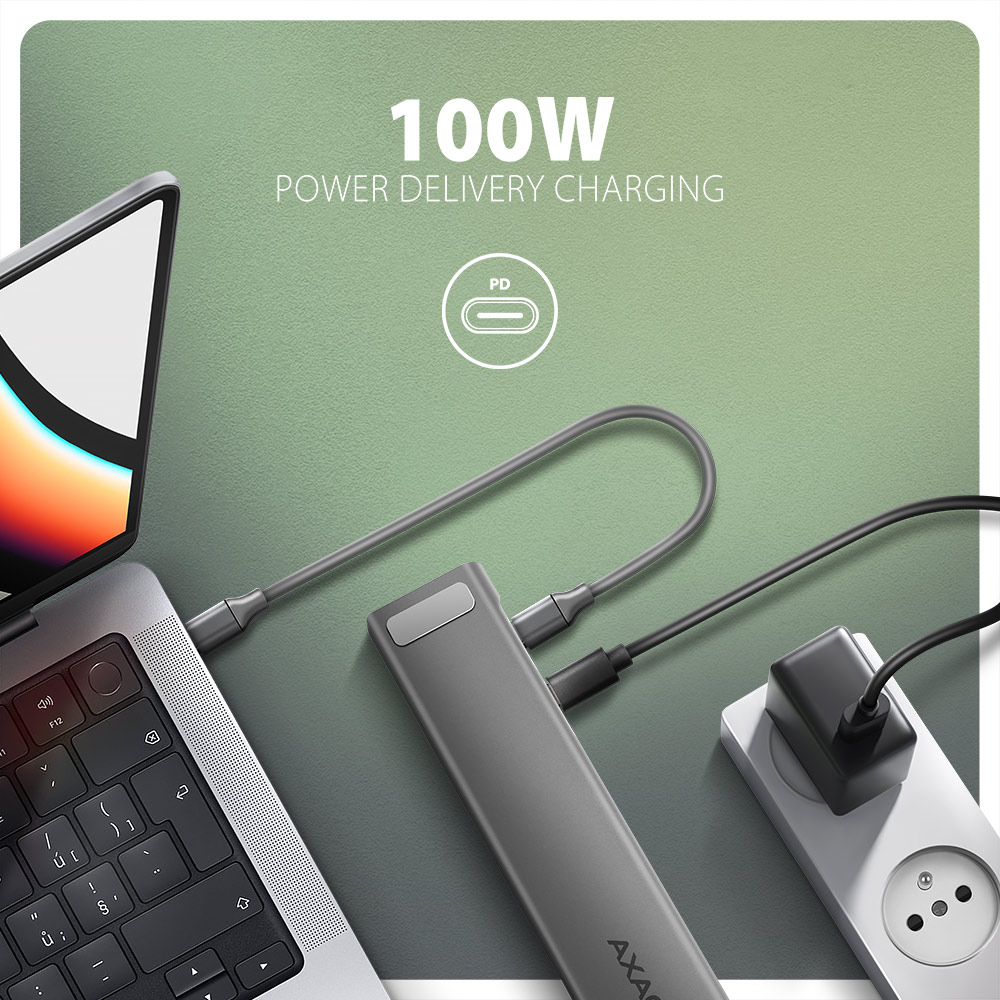
Un des connecteurs USB-C sert à connecter l'ordinateur portable à l'aide d'un câble de 25 cm fourni avec un connecteur USB-C male réversible à chaque extrémité. Le deuxième connecteur USB-C est réservé uniquement à la charge des téléphones ou ordinateurs portables via la technologie Power Delivery 3.0 avec une puissance allant jusqu'à 100W. Vous devez brancher un chargeur USB-C Power Delivery adapté dans le hub et connecter le hub à un ordinateur portable compatible Power Delivery. Cela vous libérera également un port USB-C.
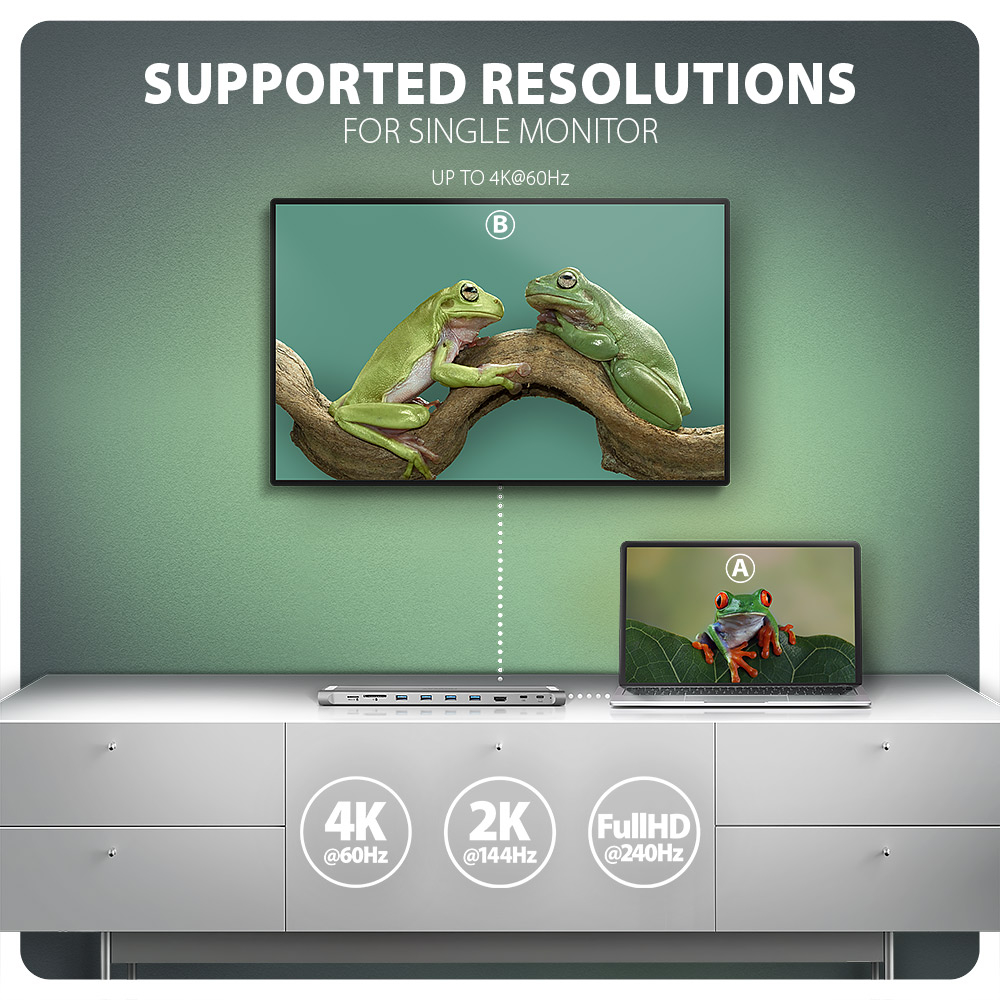
La sortie HDMI offre une image de qualité en résolution jusqu'à 4K/60Hz Ultra HD et prend en charge la transmission audio multicanal. Les fréquences élevées dans les résolutions populaires pour joueurs 2K/144Hz ou FullHD/240Hz sont également prises en charge.
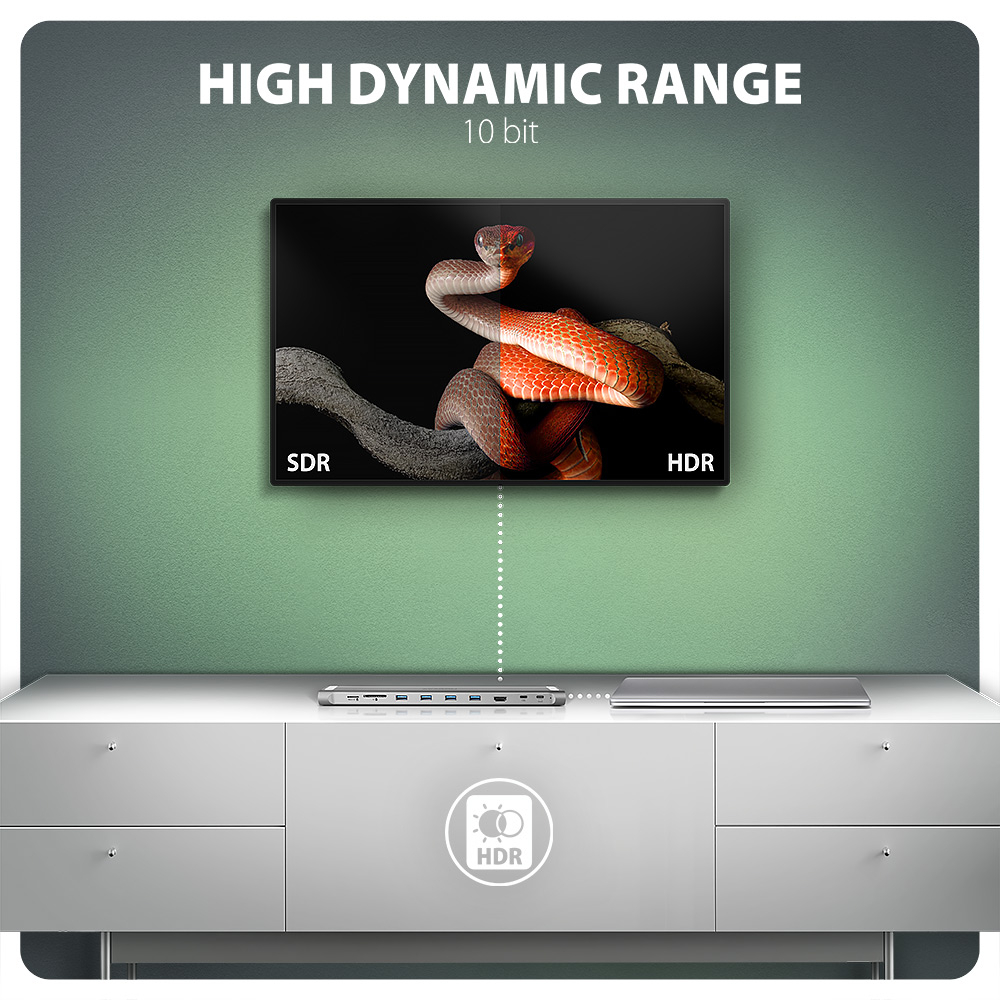
Grâce au support HDR (plage dynamique élevée), vous pouvez profiter sans limitation d’une gamme colorimétrique et de contrastes nettement étendus. Pour que les sorties vidéo fonctionnent correctement, l’ordinateur portable doit disposer d’un port USB-C avec prise en charge du DisplayPort Alternate Mode (DP Alt Mode) ou d’un port Thunderbolt 3 ou supérieur.
La carte réseau Gigabit étend l’ordinateur avec une connexion réseau rapide et stable, ajoute un connecteur RJ-45 Ethernet manquant, ou ajoute une carte réseau supplémentaire.
Le lecteur de cartes prend en charge toutes les versions des cartes SD et microSD, y compris SDXC et microSDXC avec une capacité allant jusqu’à 2 To. Le lecteur de cartes permet de travailler simultanément avec les cartes dans les deux emplacements et de copier directement d’une carte à l’autre.
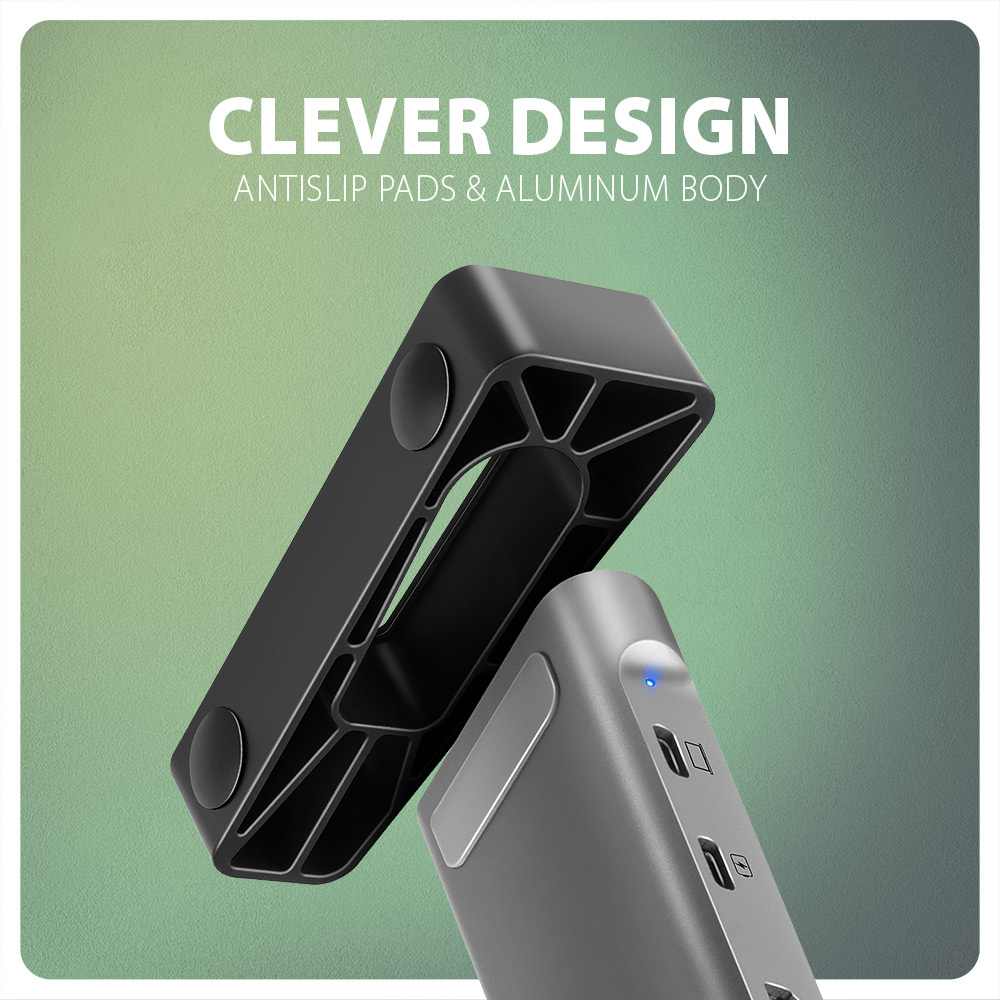
Le boîtier élégant en aluminium garantit non seulement une résistance mécanique, mais aussi un refroidissement passif. L’emballage comprend des supports qui permettent d’utiliser le hub comme support pour ordinateur portable, améliorant le refroidissement grâce à une meilleure circulation d’air sous l’ordinateur portable. Ils améliorent également l’ergonomie sur votre poste de travail.
Grâce aux fonctions Plug and Play et Hot Plug, le branchement du hub est très simple sans installation compliquée, et vous pouvez facilement connecter et déconnecter les périphériques pendant que l’ordinateur fonctionne. Le hub peut également se connecter aux téléphones avec connecteur USB-C. Vous pouvez ainsi connecter par exemple une clé USB, un clavier, une souris, un moniteur, une télévision ou un projecteur au téléphone.
Entrée (connexion à l’ordinateur portable) :
• USB 5Gbps (USB 3.2 Gen 1 / USB 3.0), connecteur USB-C female.
• Compatible avec USB 3.2 Gen 2, USB4 et Thunderbolt 3/4.
Entrée (alimentation) :
• Port USB Power Delivery 3.0 - 100W (alimentation uniquement), connecteur USB-C female.
• Alimentation de l’ordinateur portable via l’adaptateur secteur par le hub USB-C.
• L’alimentation PD doit être prise en charge à la fois par l’ordinateur portable (téléphone) et par le chargeur secteur.
Sorties USB :
• 4 ports USB 5Gbps, connecteur USB-A female.
• Le hub USB-C peut prendre en charge la connexion simultanée de deux disques externes.
• Chargement des appareils mobiles (dont iPad) avec un courant jusqu’à 1.5A depuis les ports USB-A et USB-C du hub.
Sortie vidéo :
• 1 port HDMI, connecteur HDMI A female.
• Résolution 4K 4096 x 2160 jusqu’à 60Hz.
• Résolution 2K / WQHD 2560 x 1440 jusqu’à 120Hz.
• Résolution FHD 1920 x 1080 jusqu’à 240Hz.
• La prise en charge des résolutions et fréquences maximales ci-dessus nécessite une connexion à un ordinateur avec DisplayPort version 1.4.
• Pour que la fonction de sortie vidéo fonctionne, le hub doit être branché sur un port USB-C avec prise en charge du DisplayPort Alternate Mode (DP Alt Mode) ou sur un port USB-C prenant en charge Thunderbolt 3/4. Un système d’exploitation adapté est également nécessaire. Sans ce support, la fonction de sortie vidéo ne sera pas disponible.
• Support HDR (High dynamic range, prise en charge 10 bits) - reproduction réaliste des détails clairs et foncés.
• Support HPD (Hot-Plug-Detect).
• Support TMDS (Transition Minimized Differential Signaling).
• Prise en charge complète de HDCP 1.4 et 2.3 (High-bandwidth Digital Content Protection).
• Support audio 2 canaux avec une fréquence d’échantillonnage allant jusqu’à 192 kHz et un son 24 bits – dépend de l’appareil source et de l’appareil final, c’est-à-dire l’ordinateur portable/téléphone et la TV/moniteur/récepteur AV.
Sortie RJ-45 :
• Interface Gigabit Ethernet avec connecteur RJ-45 pour câble UTP ou STP.
• Vitesses de transmission Ethernet prises en charge : 10/100/1000 Mb/s.
• Spécifications prises en charge IEEE 802.3 10Base-T, IEEE 802.3u 100Base-TX, IEEE 802.3ab 1000Base-T.
• Auto-détection 10/100/1000 Mb/s.
• Prise en charge de la fonction Wake-on-LAN.
Lecteur de cartes - deux emplacements :
• Emplacement Micro SD : microSD / microSDHC / microSDXC / TransFlash.
• Emplacement SD : SecureDigital / SDHC / SDXC, MultiMedia Card, MMC, MMC Dual Voltage, MMC mobile, RS-MMC, avec adaptateur - miniSD, microSD / microSDHC / microSDXC, MMC Micro.
• Support UHS-I. Vitesse jusqu’à 104 MB/s. Support matériel des fonctions ECC et CRC.
• 2 LUN - le lecteur est reconnu comme deux unités de disque. Possibilité de copier d’une carte à l’autre.
Autres caractéristiques :
• Possibilité de connecter des appareils à chaud grâce au support Hot Plug.
• Support complet Plug and Play.
• Support du mode économie d’énergie.
• Alimentation par USB bus power ou à partir d’un chargeur PD.
• Boîtier en aluminium durable pour un meilleur refroidissement du hub.
• LED indiquant la connexion permanente du hub à l’ordinateur.
• Câble blindé de qualité garantissant une haute vitesse de communication et un minimum d’interférences indésirables.
• Dimensions 283 x 42 x 17 mm.
• Poids 133 g.
• Longueur du câble USB-C male 25 cm.
Systèmes d’exploitation pris en charge :
• Windows 10 / 11 et versions ultérieures, macOS, Linux, Chrome OS et Android.
• La compatibilité dépend du système d’exploitation mis à jour et du support fourni par le fabricant de l’appareil.
• Le DisplayPort Alternate Mode (DP Alt Mode) est pris en charge uniquement dans les systèmes d’exploitation mis à jour et nécessite également un support matériel de l’appareil (ordinateur portable, téléphone).
• Les pilotes de la carte graphique peuvent également affecter le bon fonctionnement du produit. Nous recommandons de télécharger la dernière version des pilotes.
Contenu de l’emballage :
• hub USB-C,
• câble USB-C de 25 cm,
• supports d’élévation,
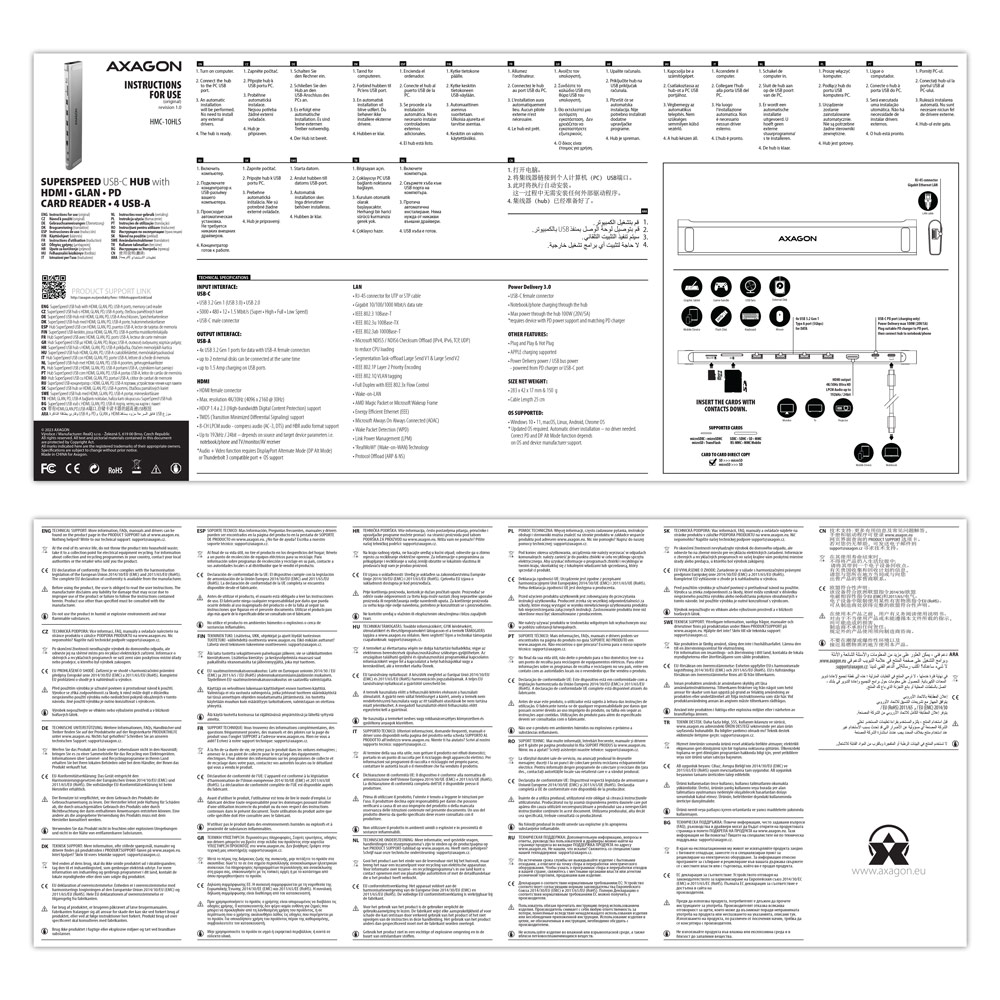
• manuel multilingue CZ / DE / DK / ENG / ESP / FIN / FR / GR / HR / HU / IT / NL / PL / PT / RO / RU / SK / SWE / BG / CN / TR / ARA,
• emballé dans une boîte en carton avec trou de suspension.

A): The necessary drivers are already included in all operating systems and install completely automatically, and no additional drivers are needed.
B): Plug the USB hub into another USB port (on the back of the computer where the USB ports are integrated directly into the motherboard). It should re-detect the USB hub and reinstall the drivers. Alternatively, try replacing the USB cable. The obsolete driver of the USB controller could also cause problems. Manufacturers of USB 3.0 chipsets often issue new versions of drivers to improve compatibility with different devices. If the problem with the USB bub persists, plug it into the USB port of another computer to verify its functionality.
A): Drivers are included with operating systems and are installed completely automatically. The card reader is detected as a standard storage device, such as a USB flash disk, no other drivers are available.
B): No other drivers need to be installed and are not even available. If you continue to have problems with your reader, check out more tips that can help you troubleshoot problems.
A): If the network card is not displayed in "Device Manager", a USB port (or a PCIe slot in the event of an internal network card) may be malfunctioning.
B): Try plugging the network card into another USB port (or another PCIe slot on the PC motherboard in the event of an internal network card, or temporarily disconnect all other PCIe cards). The network card should be detected and you should be prompted to install the drivers. If the problem persists, plug the network card into the USB port (PCIe slot) of another computer to verify its functionality.
A): If the card reader is not displayed in "Device Manager," there may be a USB port (or a 20-pin USB 3.0 connector on the PC motherboard in the case of an internal reader) malfunction.
B): Try plugging the reader into another USB port (or another 20-pin USB 3.0 connector on the PC motherboard, if available, in the case of an internal reader). The card reader should be detected and the drivers loaded automatically. If this does not solve the problem, try checking the USB controller status in "Device Manager" in the "USB Drivers" section. If the problem persists, plug the card reader into the USB port of another computer to verify its functionality.
A): If this happens, it means that the operating system failed to get the necessary information to install the drivers.
B): The cause may be a defective USB cable or damaged device. Another option is to remove the record of the connected USB device using "USBDeview". After connecting the reader, the drivers should be reloaded. If the problem is caused by a driver error, the problem should be eliminated. If the problem persists, plug the card reader into the USB port of another computer to verify its functionality.
A): If this happens, it means that the operating system failed to get the necessary information to install the drivers.
B): The cause may be a defective USB extension cable or damaged device. If the problem persists, plug the network card into the USB port of another computer to verify its functionality.
A): If this happens, it means that the Windows operating system did not assign a drive letter to the new storage device.
B): If the drive letter is not assigned, open "Disk Management", right-click on the desired drive and manually assign the drive letter. Another option is that the correct formatting of the memory card is not performed. Format the card in "Disk Management" or in the device on which you are using the card (for example, the camera).
A): In the vast majority of cases, the USB hub can handle connection of one 2.5" external box. If more external boxes are connected, a higher current is needed that ordinary USB cannot deliver.
B): In this case, an auxiliary power supply is required. Use a USB hub with auxiliary power supply.
A): Before connecting the USB network card to an Android device (tablet), you first need to verify with the device manufacturer whether the device supports the Ethernet network feature and also whether the USB network card drivers are included in your specific ANDROID ROM installation.
B): Use a USB connector with OTG support to connect the USB network card to your tablet. If the device (tablet) is equipped with a Mini USB or Micro USB connector, use an OTG reduction or cable to connect it.
A): You can use a passive USB cable to connect a USB hub to your computer. However, with longer cables the USB hub may not work reliably.
B): In this case, we recommend using an active extension USB repeater cable, such as AXAGON ADR-205 or ADR-210.
A): The sound interference is probably caused by the wireless mouse transmitter.
B): We recommend placing the mouse transmitter as far away from the sound card as possible (preferably on the opposite side of the computer – connect the transmitter to a USB port on the front panel of the PC and the sound card to a USB port on the back panel – use a USB extension cable if necessary). In the case of a laptop, place one device on each side.
A): The problem could be a lack of resources, check (when a problem occurs) the processor load and operating memory filling in "Task Manager".
B): If the CPU usage is 100% or memory is full, you need to find out what causes this situation. Another option is to connect a sound card to another computer to verify that the sound card is not damaged.
A): You probably have allowed to listen to the microphone in Microphone Properties.
B): To disable this feature, follow these steps: Start -> Control Panels -> Hardware and Sound -> Sound -> Recording -> Microphone (USB Sound Device) -> Properties -> Listen -> Listen to this device - uncheck this box and confirm with "Apply".
A): Yes, it is possible to play two different tracks simultaneously on one computer.
B): This is primarily a software matter, requiring a player that supports redirecting sound to a different audio output than the one set as the “default” in the operating system. Such functionality is supported, for example, by VLC media player.
A): If this happens, it means that the operating system failed to get the necessary information to install the drivers.
B): The cause may be a defective USB extension cable or damaged device. If the problem persists, plug the network card into the PCIe slot of another computer to verify its functionality.
A): By initializing the disk, you can set the mode in which the hard disk will work
B): You can use the partition with the master boot record (MBR) or the GUID partition table (GPT). For disk up to 2TB, use the MBR option, we recommend selecting GPT on a larger disk than 2TB. Subsequently, the initialized disk should be formatted.
A): By initializing the disk, you can set the mode in which the hard disk will work.
B): You can use the partition with the master boot record (MBR) or the GUID partition table (GPT). For disk up to 2TB, use the MBR option, we recommend selecting GPT on a larger disk than 2TB. Subsequently, the initialized disk should be formatted.
A): If this happens, it means that the Windows operating system did not assign a drive letter to the new storage device.
B): If the drive letter is not assigned, open "Disk Management", right-click on the desired drive and manually assign the drive letter. If the drive letter can not be assigned to the disk, it is possible that the disk is formatted as "dynamic". If you want to keep disk data, connect it to the original device and make a backup of the disk. Then convert it to a normal disk, initialize it to MBR (or GPT, see other points), and then perform Low Level Format (e.g. using the Low Level Format Tool)
A): The newly purchased disk must be initialized before first use.
B): If the new disk is not initialized automatically, open "Disk Management", right-click on the desired disk and initialize it.
In the ACTIVE profile, set the hard drive sleep time for battery and mains power to 0 minutes / Never.
A) Path in Windows 10: Settings > System > Power & Sleep > Additional power settings > in the ACTIVE profile Change Schema Settings> Change advanced power settings > Hard drive > Turn off hard disk after
B) Path in Windows 11: Search for: Control Panel > Hardware and Sound > Power Options > in the ACTIVE profile Change Schema Settings> Change advanced power settings > Hard disk > Turn off hard disk after.
You need to set the function of the headphone buttons to track skipping/playback control.
A) Example setting for Xiaomi phones (HyperOS overlay):
1st option:
In the notification bar, when headphones are connected, Audio playback via USB > click > Change headphone buttons to Playback control.
2nd option:
Settings > Sounds & Vibration > Sound effects > Change headphone buttons to Playback control.
B) Example setting for Xiaomi phones (MIUI overlay): Settings > Sounds & Vibration > Headphones > Change headphone buttons to Playback – back/next.
The keyboard is set to Apple mode. Switch it using Fn+S (mode for Windows and Android).
The keyboard is set to Windows mode. Switch it with Fn+A (Apple mode).
A: Check if the USB-C in the device supports video output.
B: Leave the HUB connected to the device and turn off the HUB via the ON/OFF button. Wait 5 seconds and then turn it back on with the ON/OFF button.
A: Check if your charger and device support the Power Delivery protocol and if the charger has sufficient power.
B: Leave the HUB connected to the device and turn off the HUB via the ON/OFF button. Wait 5 seconds and then turn it back on with the ON/OFF button.