


 English
 Čeština
 Slovenčina
 Deutsch
 Magyar
 Polski
 Français
AXAGON CLR-M2XL tested: M.2 SSD cooler kept the controller below 58 °C
A fast SSD can get its head – the controller – seriously hot under full load. The editorial team of Svět hardware magazine tested how different types of cooling affect the high-performance XPG MARS 980 BLADE drive. They also included our AXAGON CLR-M2XL heatsink in the test.
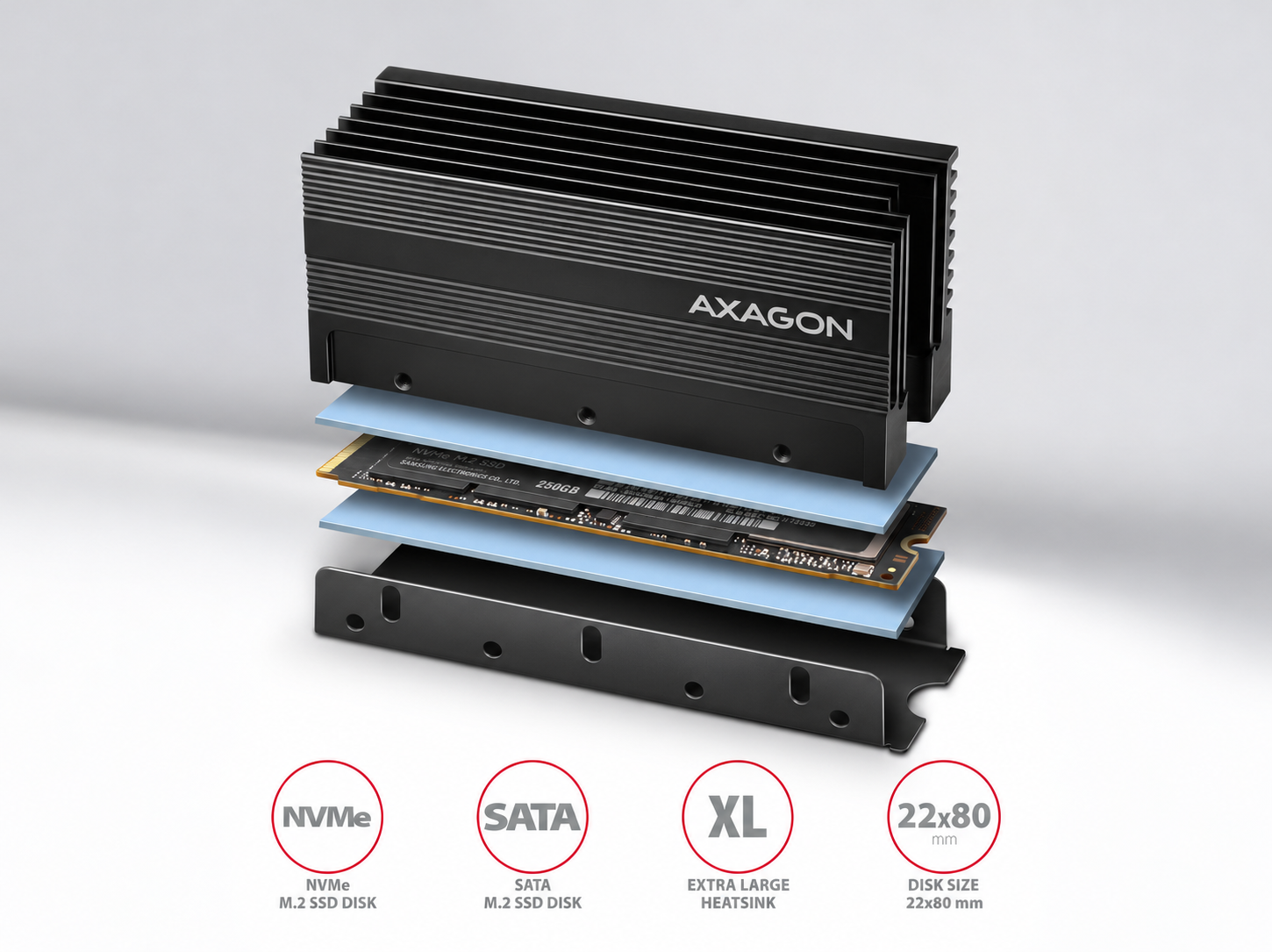
Image source: Svět hardware
Test results
The test showed that without more effective cooling, a fast SSD can overheat under sustained load and limit its performance. In this case, the thin metal plate supplied with the drive was not enough on its own, and thermal protection kicked in during the test.
The AXAGON CLR‑M2XL helped the drive handle sustained full load without thermal throttling. In the fifteen-minute test, the controller temperature with the AXAGON CLR-M2XL heatsink reached 66 °C. The more massive passive heatsink of the motherboard was slightly more effective in this particular test, but the CLR-M2XL proved to be a functional standalone solution.
The best result was achieved by the AXAGON CLR‑M2XL fitted with ARCTIC TP-4 thermal pads. In this combination, the controller temperature did not exceed 58 °C and the heatsink took first place in the comparison. This is therefore the result of the whole setup with ARCTIC pads, not of the AXAGON CLR-M2XL heatsink with its original pads. You can find the details in the full test on Svět hardware.
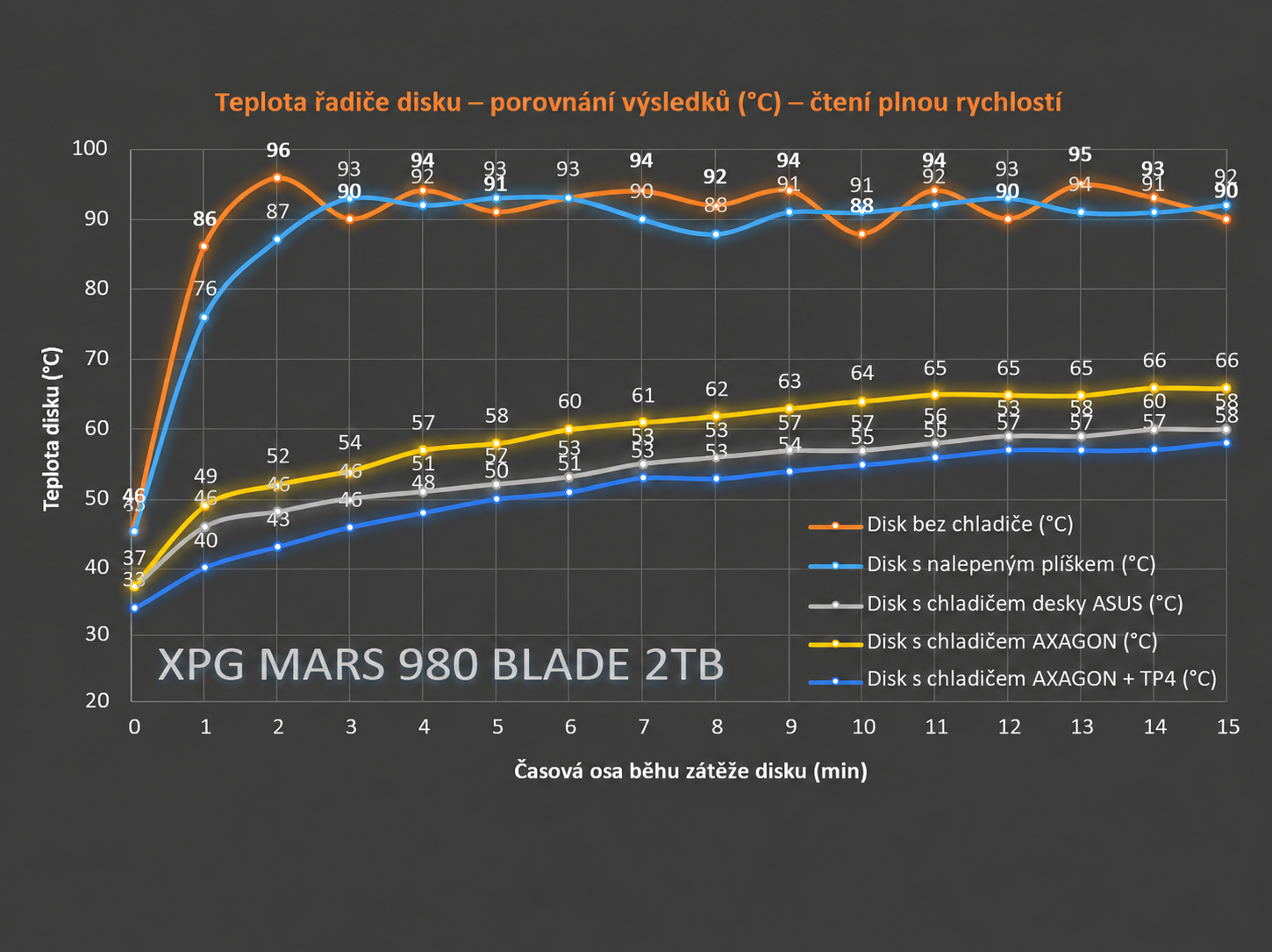
Image source: Svět hardware
Who is the CLR-M2XL for
The AXAGON CLR‑M2XL will be appreciated above all by users of high-performance M.2 SSDs that heat up significantly under demanding operation. It is also suitable for computers whose motherboard has no M.2 heatsink of its own, or if you want to use a standalone cooling solution.
The heatsink can be useful for long transfers of large files, video editing or other tasks where the drive works under load for an extended period. However, the actual result may vary depending on the SSD used, the airflow in the PC case and other parts of the setup. The Svět hardware test was carried out with a specific XPG MARS 980 BLADE drive, so the measured values cannot automatically be applied to all SSDs.
Installation
The AXAGON CLR-M2XL consists of a metal bottom part and a finned aluminium top body. The package includes thermal pads of various thicknesses, mounting screws and instructions with an illustrated procedure. During installation, it is important to choose the pads according to the SSD's design and position them correctly so that the drive's components have good contact with the heatsink.
Before installation, it is worth checking the space around the M.2 slot. The AXAGON CLR-M2XL may need to be fitted in place of the motherboard's original heatsink; in the tested setup, the editors removed its bottom part. Therefore, also check that the heatsink does not collide with other components.
FAQ
Will the CLR‑M2XL prevent any SSD from overheating?
The result depends on the specific drive, the setup and the way it is used. The test confirmed that the AXAGON CLR-M2XL helped the tested SSD handle sustained load without thermal performance limiting.
Can the 58 °C result be achieved with the heatsink in its standard configuration?
The editors achieved this value using the AXAGON CLR-M2XL with ARCTIC TP-4 thermal pads. It is therefore not the result of the heatsink alone with its original pads.
Does a PCIe 5.0 SSD need a heatsink?
In a desktop computer, almost always yes. Fast NVMe SSDs heat up under sustained load and reduce their performance once they exceed the temperature limit (so-called thermal throttling). In the Svět hardware test, the thin plate supplied with the XPG MARS 980 BLADE drive was not enough on its own. With the AXAGON CLR-M2XL heatsink, the drive handled fifteen minutes of full load without throttling.
Will the CLR-M2XL fit under a graphics card?
It depends on the location of the M.2 slot. The CLR-M2XL is 32 mm high (dimensions 76 × 24 × 32 mm), so it needs a slot with no graphics card or other component above it. In small cases, also check the clearance from the side panel. The heatsink is suitable for M.2 2280 SSDs, both single-sided and double-sided.
Source: Petr Kupský, Svět hardware, 24 November 2026
Follow!


