Product code: HMC-WL9
Category: Docking stations , Multiple video outputs + LAN , Combined & multipurpose , All Products
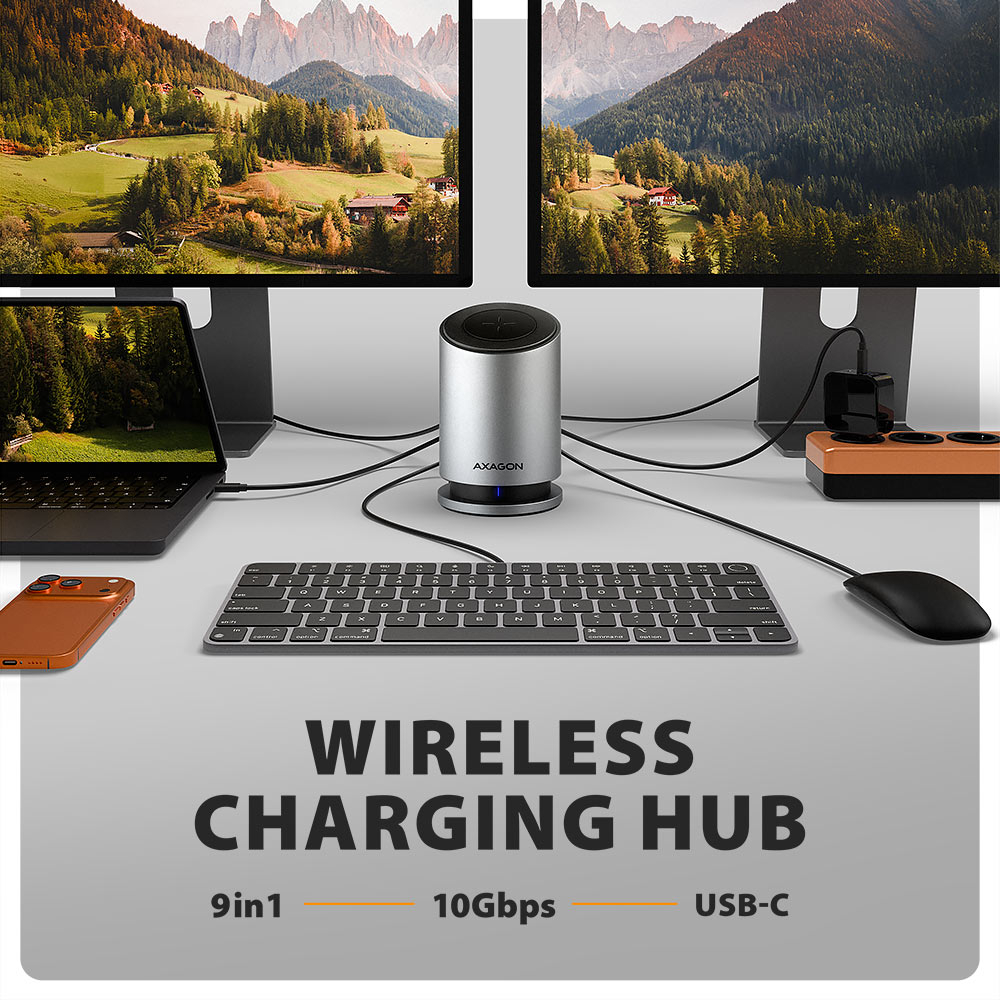
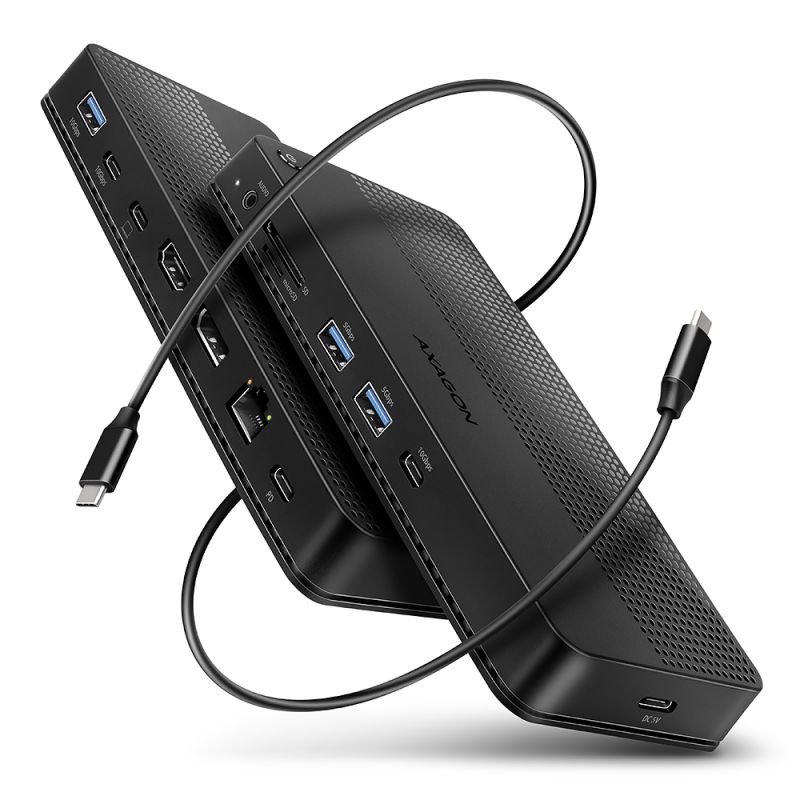
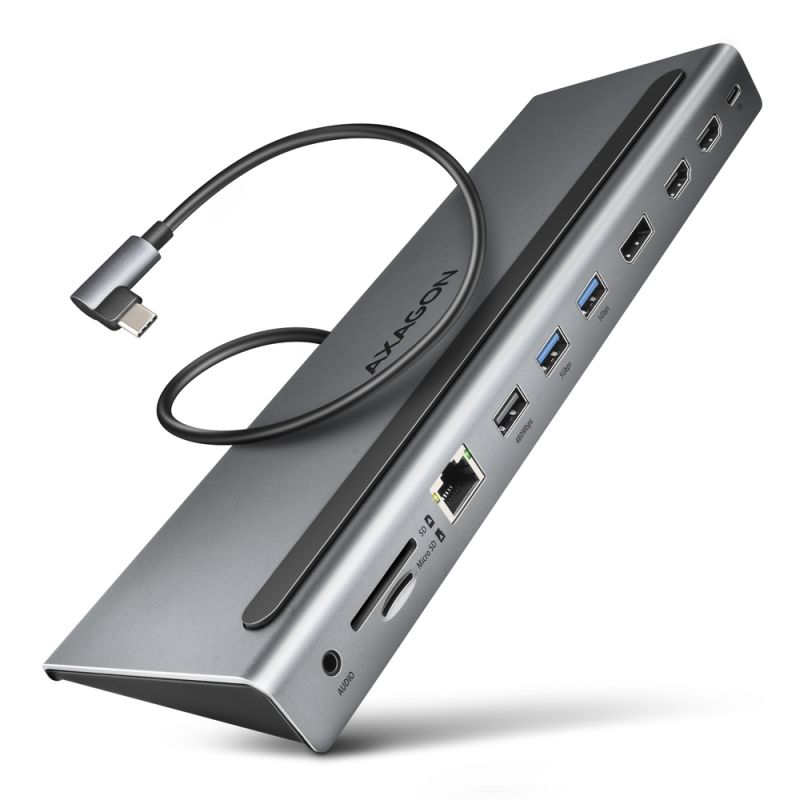
The multi-port USB-C 10 Gbps AXAGON HMC-WL9 WIRELESS CHARGING 9in1 hub expands your laptop, computer or phone with two video outputs, a LAN connector, USB ports and a wireless charger. You connect your laptop to the hub via a 60 cm long USB-C cable. This gives you immediate access to connectivity for two 4K monitors, four USB devices and an RJ-45 connector for a Gigabit Ethernet network. At the same time, you gain the option of powering your notebook using Power Delivery technology. Thanks to compatibility with Thunderbolt 3/4/5, the 9in1 docking station works with laptops such as the Apple MacBook Air or MacBook Pro.
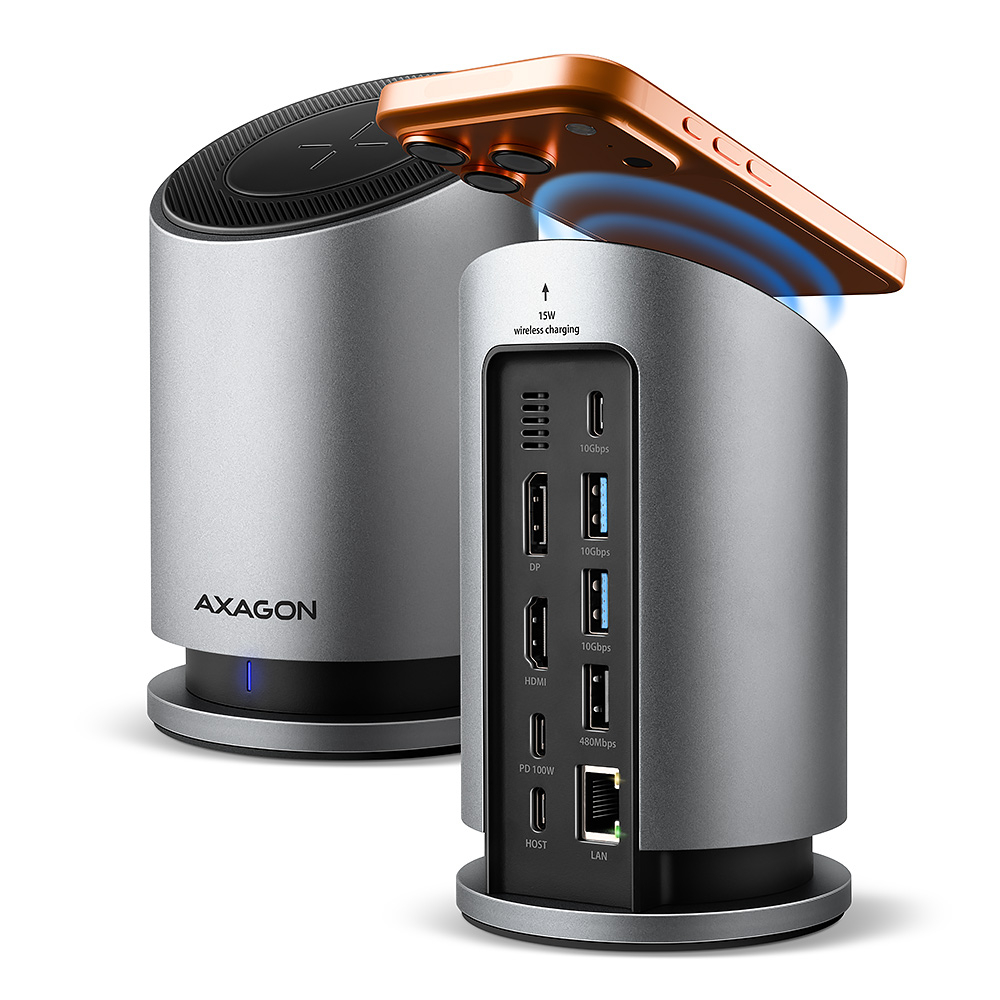
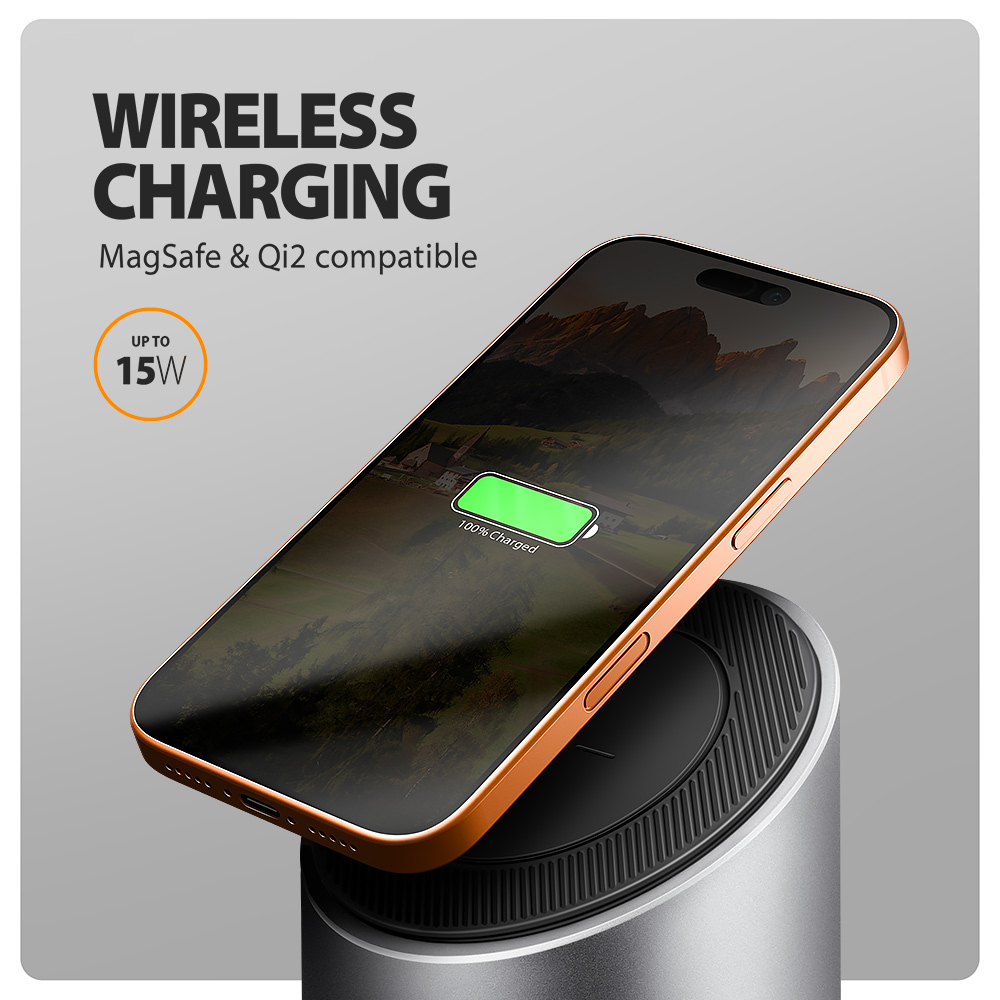
Wireless charging for mobile phones with power up to 15 W is integrated directly into the body of the hub. Thanks to the magnetic mounting system, you only need to place your phone on the surface – it automatically aligns into the optimal position. Charging is therefore maximally efficient, safe and convenient. Naturally, it is compatible with the Qi1, Qi2 and MagSafe standards. To achieve maximum wireless charging performance, a 100 W PD charging adapter must be used.
The wireless charging technology is compatible with a wide range of devices, such as Apple iPhone, Samsung, Google Pixel, Xiaomi, Nothing Phone, as well as models from OnePlus, Huawei, Motorola and others. Thanks to the universal Qi standard, it is easy to charge older models with lower power output.
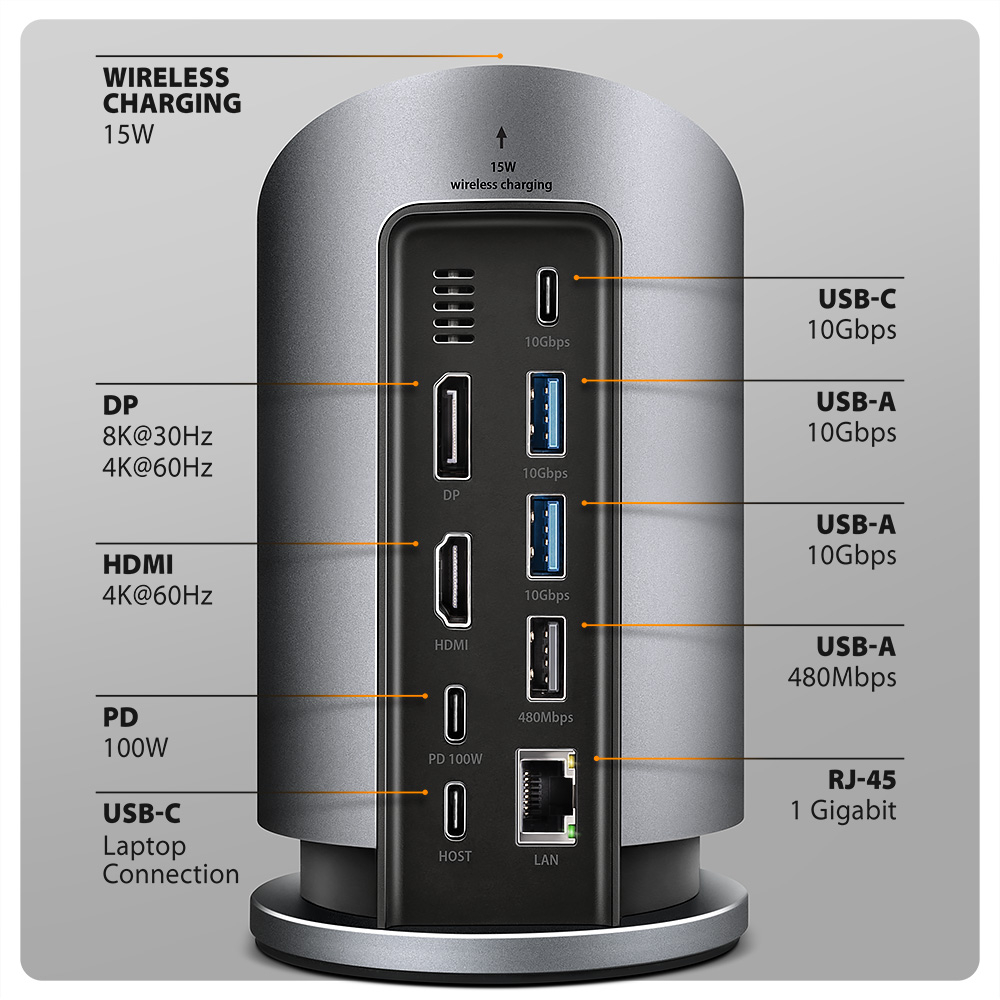
The USB hub with 4 USB ports offers high-speed connectivity – two USB-A and one USB-C with speeds up to 10 Gbps for fast data transfer, and one USB-A 480 Mbps ideal for a keyboard or mouse. Thanks to USB 3.2 Gen 2 interface, the hub's transfer rate is up to 10 Gb/s. The hub can also handle permanent connection of several external drives simultaneously.
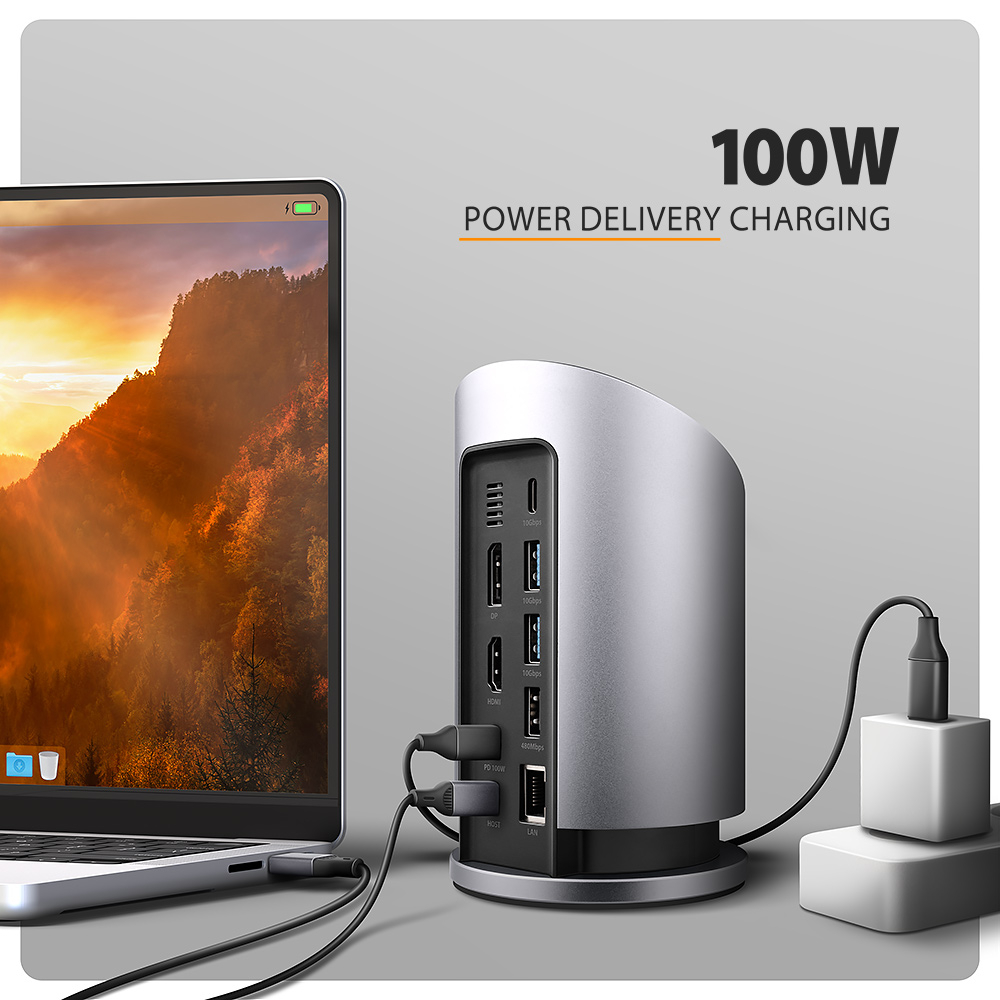
The USB-C (PD) input is designed for a Power Delivery charger. This way, both the notebook and the dock are powered directly from a PD charger using Power Delivery 3.0 technology with power up to 100 W.
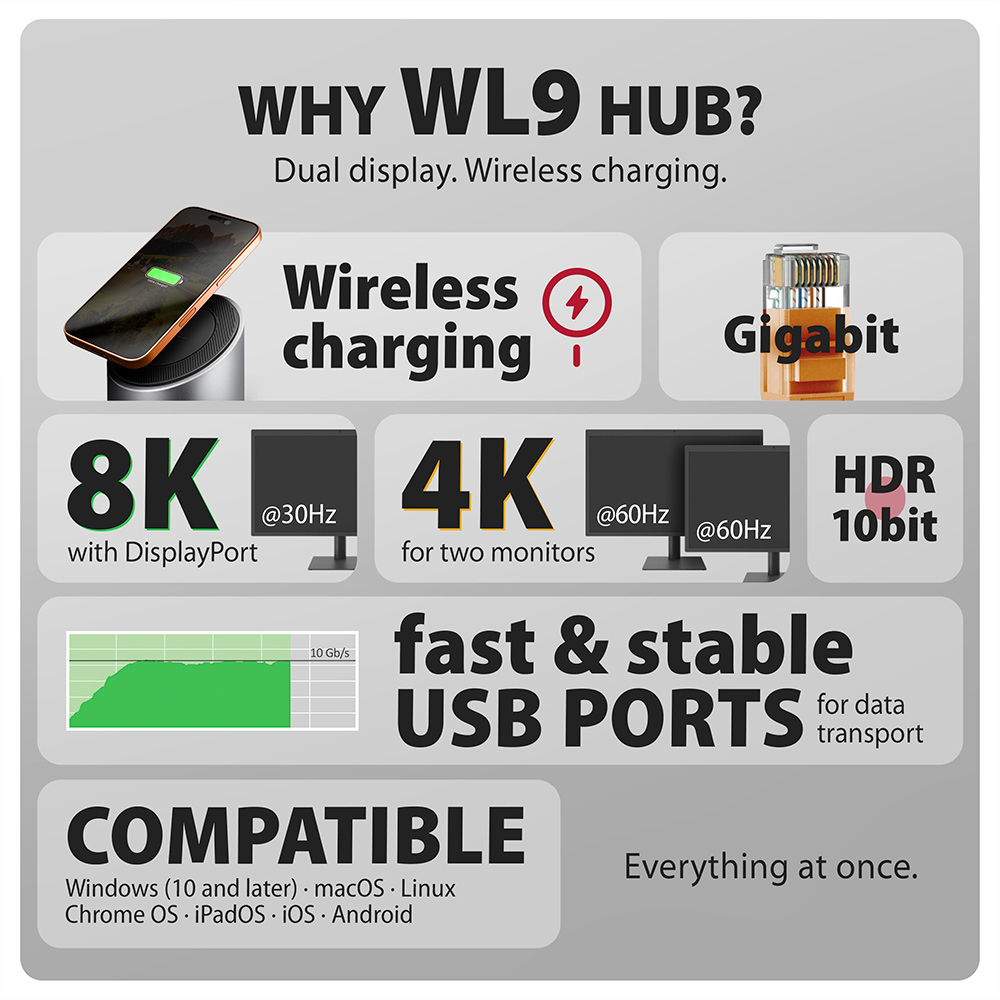
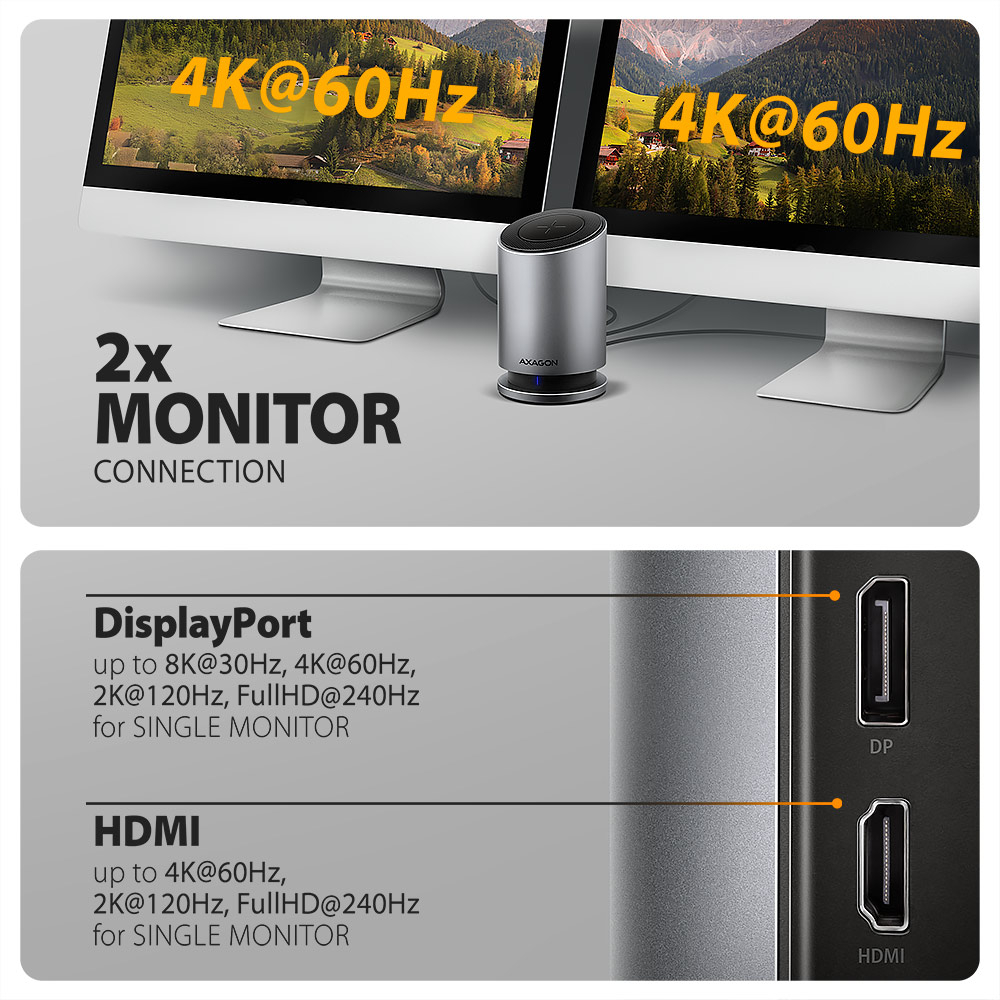
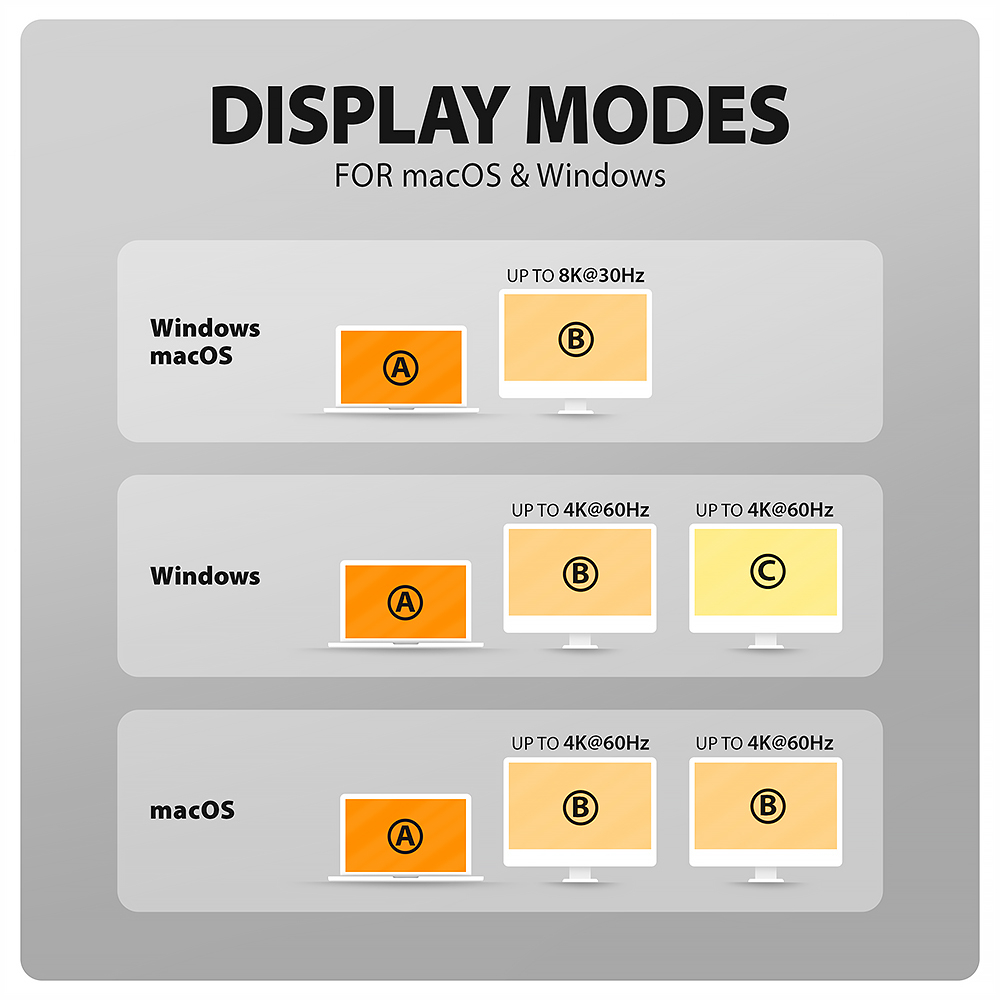
Two video outputs – HDMI and DisplayPort allows you to connect external monitors, TVs or projectors with up to 4K/60Hz Ultra HD resolution when two monitors are connected at the same time. Other resolutions are also supported, such as 2K/120Hz Quad HD or 1080p/240Hz Full HD and multichannel audio transmission trough HDMI. Thanks to HDR support, you can enjoy a significantly expanded range of colours and contrasts.
Gigabit network card extends your computer by a fast and stable network connection, adds the missing RJ-45 Ethernet connector or another network card.
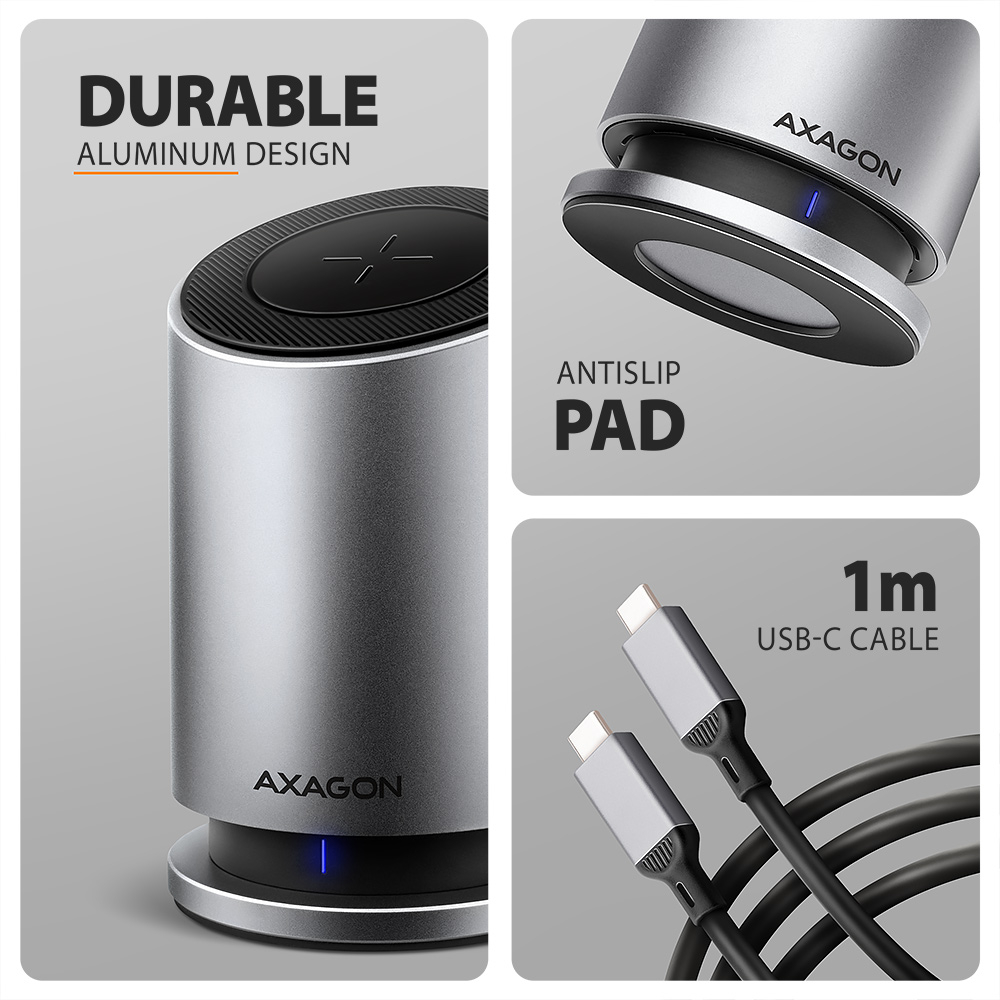
The aluminum body not only looks great, but also provides mechanical durability and passive cooling. Thanks to the rubber pad on the base, the station stays firmly in place. USB-C hub is an ideal accessory for laptops without USB-A connectors and video output. Thanks to the Plug & Play and Hot Plug functions, connecting the hub is very simple without complicated installation, and peripherals can also be easily connected and disconnected while the computer is running.
For the proper function of the hub, the USB-C port of your notebook must support video output (DisplayPort Alternate Mode or Thunderbolt 3 and above) and Power Delivery power.
The hub can easily handle connection to phones and tablets with a USB-C connector. For example, you can connect a flash drive, keyboard, mouse, display, TV or projector to the phone.
Input (connection to a computer, tablet or phone):
• USB 10 Gbps (USB 3.2 Gen 2), USB-C male connector.
• Compatible with USB 5 Gbps, USB 20 Gbps, USB 40 Gbps, Thunderbolt 3/4/5.
Input (power supply):
• USB Power Delivery 3.0 – 100 W, USB-C female connector.
• Charging of the laptop from the power adapter via USB-C hub.
• PD power must be supported by the laptop (tablet, phone), the cable and the wall charger.
Wireless charging:
• Supports 5 W, 7.5 W, 10 W and 15 W wireless charging.
• Compatible with Qi1, Qi2 and Apple MagSafe technologies.
• Supports magnetic alignment for efficient charging.
• A 100 W PD charging adapter must be used to achieve maximum wireless charging performance.
Examples of compatible Qi1 and Qi2 wireless charging phones:
• Apple iPhone: Compatible with iPhone 8 to 17 models, including the X, 11, 12, 13, 14, 15, 16 and 17 series, and all mini, Plus, Air, Pro and Pro Max variants.
• Samsung Galaxy: Compatible with Samsung Galaxy S8 to S25 models, including the S, S+, S Ultra, Z Flip (Flip3–Flip6) and Z Fold (Fold3–Fold6) series.
• Google Pixel: Compatible with Google Pixel 4 to 10 models, including the Pixel 4 XL, 6 Pro, 7 Pro, 8 Pro, 9 Pro, 10 Pro and Pixel Fold.
• Note: To achieve the highest charging speed, the phone needs to be properly centred. Thanks to the magnetic ring in the device or its case, the smartphone easily aligns itself into the optimal position.
USB outputs:
• 1× USB 480 Mbps port, USB-A female connector.
• 2× USB 10 Gbps port, USB-A female connector.
• 1× USB 10 Gbps port, USB-C female connector.
• USB-C hub can handle the connection of several external drives at the same time.
• Charging of mobile devices (including iPad) from the hub's USB-A and USB-C ports.
Video output:
• 1× DP port, DP female connector.
• 1× HDMI port, HDMI A female connector.
Maximum supported resolution:
• 1 monitor (DP) – up to 8K/30Hz Ultra HD, 4K/60Hz Ultra HD, 2K/120Hz Quad HD, 1080p/240Hz Full HD.
• 1 monitor (HDMI) – up to 4K/60Hz Ultra HD, 2K/120Hz Quad HD, 1080p/240Hz Full HD.
• 2 monitors (DP + HDMI) – up to 4K/60Hz Ultra HD, 2K/120Hz Quad HD, 1080p/240Hz Full HD.
Video features:
• For Apple devices running macOS, the maximum refresh rate is usually limited to 60Hz.
• To achieve maximum resolution and frequency values on video outputs, the hub must be plugged into a USB-C port supporting DisplayPort Alternate Mode (DP Alt Mode) version min. 1.4 or a USB-C port supporting min. Thunderbolt 3. A suitable updated OS and up-to-date graphics drivers are also required.
• HDR support (High dynamic range, 10-bit support) - realistic reproduction of light and dark details.
• HPD (Hot-Plug-Detect) support.
• TMDS (Transition Minimized Differential Signalling) support.
• HDCP 1.4 and 2.3 (High-bandwidth Digital Content Protection) full support.
• HDMI support for 8-channel LPCM audio, compressed audio (AC-3, DTS) and HBR audio formats.
• HDMI support for sampling rates up to 192 kHz and up to 24-bit audio – depends on the source and destination device, i.e., notebook/phone and TV/monitor/AV receiver.
RJ-45 output:
• Gigabit Ethernet interface with RJ-45 connector for UTP or STP cable connection.
• Supported transmission rates for the Ethernet interface 10/100/1000 Mb/s.
• Supported IEEE 802.3i 10Base-T, IEEE 802.3u 100Base-TX, IEEE 802.3ab 1000Base-T specifications.
• 10/100/1000 Mb/s auto-detection.
Other features:
• Possibility to connect your device while running thanks to the Hot Plug support.
• Full Plug and Play support.
• Standby mode support.
• Power supply via USB bus - USB bus power.
• Power supply via PD charger (not included).
• The LED indicates the connection of the dock to the computer with a steady glow.
• High quality shielded cable ensures fast communication speed and minimal unwanted interference.
• Dimensions 84 × 84 × 140 mm (W × D × H).
• Weight 440 g (without cable).
• USB-C – USB-C cable length 60 cm for connecting the dock to a laptop.
Supported operating systems:
• Windows 10 / 11, macOS, Linux, iPadOS, iOS, Chrome OS and Android.
• Compatibility depends on the operating system and device manufacturer support.
• DisplayPort Alternate Mode (DP Alt Mode) is only supported in updated OS and also depends on support from device (laptop, tablet, phone).
• Graphics card drivers may also affect the correct operation of the product. We recommend downloading the latest version of drivers.
Package contains:
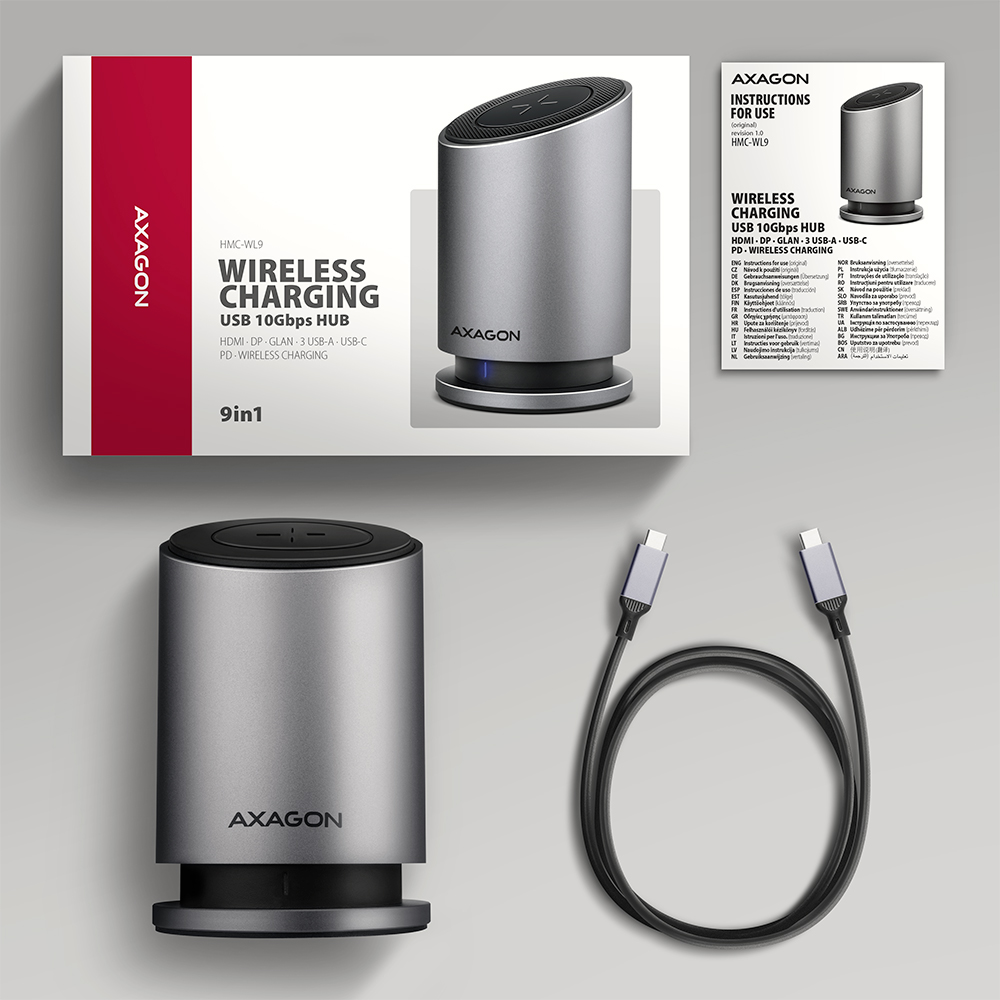
• USB-C docking station,
• cable USB-C – USB-C length 60 cm,
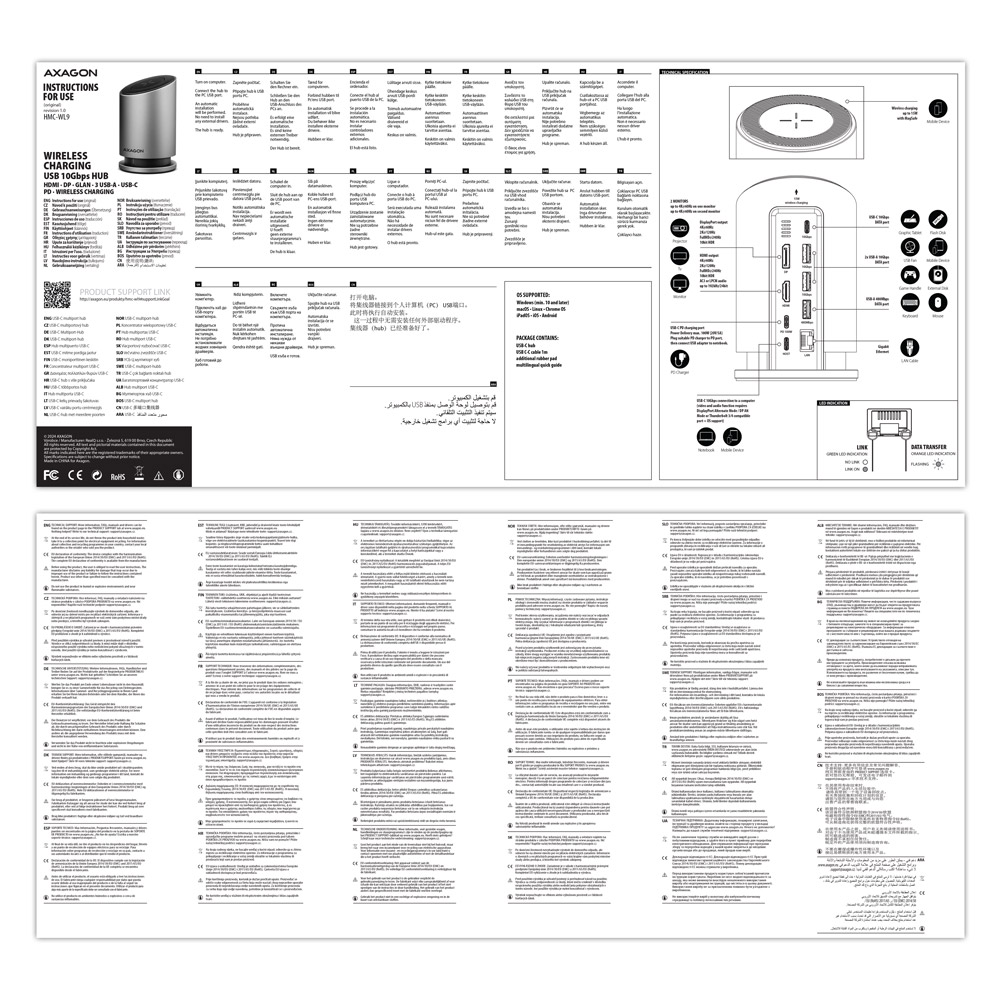
• multilingual manual CZ / DE / DK / ENG / ESP / EST / FIN / FR / GR / HR / HU / IT / LT / LV / NL / NOR / PL / PT / RO / SK / SLO / SRB / SWE / TR / UA / ALB / BG / BOS / CN / ARA,
• packed in a cardboard box.

• USB-C docking station
• cable USB-C – USB-C length 60 cm
• multilingual manual
- printed multilingual manual – CZ / DE / DK / ENG / ESP / EST / FIN / FR / GR / HR / HU / IT / LT / LV / NL / NOR / PL / PT / RO / SK / SLO / SRB / SWE / TR / UA / ALB / BG / BOS / CN / ARA
- a cardboard box
- package dimensions: 13.3 × 20.7 × 10 cm
- weight of 1 pc package: 815 g
- EAN: 8595247908735
- number of pieces in the box: 20
- total weight of the box: 17,9 kg G. W.
- box dimensions: 24 × 52 × 55 cm
HMC-WL9 – multilanguage manual – CZ / DE / DK / ENG / ESP / EST / FIN / FR / GR / HR / HU / IT / LT / LV / NL / NOR / PL / PT / RO / SK / SLO / SRB / SWE / TR / UA / ALB / BG / BOS / CN / ARA
A): The necessary drivers are already included in all operating systems and install completely automatically, and no additional drivers are needed.
B): Plug the USB hub into another USB port (on the back of the computer where the USB ports are integrated directly into the motherboard). It should re-detect the USB hub and reinstall the drivers. Alternatively, try replacing the USB cable. The obsolete driver of the USB controller could also cause problems. Manufacturers of USB 3.0 chipsets often issue new versions of drivers to improve compatibility with different devices. If the problem with the USB bub persists, plug it into the USB port of another computer to verify its functionality.
A): Drivers are included with operating systems and are installed completely automatically. The card reader is detected as a standard storage device, such as a USB flash disk, no other drivers are available.
B): No other drivers need to be installed and are not even available. If you continue to have problems with your reader, check out more tips that can help you troubleshoot problems.
A): If the network card is not displayed in "Device Manager", a USB port (or a PCIe slot in the event of an internal network card) may be malfunctioning.
B): Try plugging the network card into another USB port (or another PCIe slot on the PC motherboard in the event of an internal network card, or temporarily disconnect all other PCIe cards). The network card should be detected and you should be prompted to install the drivers. If the problem persists, plug the network card into the USB port (PCIe slot) of another computer to verify its functionality.
A): If the card reader is not displayed in "Device Manager," there may be a USB port (or a 20-pin USB 3.0 connector on the PC motherboard in the case of an internal reader) malfunction.
B): Try plugging the reader into another USB port (or another 20-pin USB 3.0 connector on the PC motherboard, if available, in the case of an internal reader). The card reader should be detected and the drivers loaded automatically. If this does not solve the problem, try checking the USB controller status in "Device Manager" in the "USB Drivers" section. If the problem persists, plug the card reader into the USB port of another computer to verify its functionality.
A): If this happens, it means that the operating system failed to get the necessary information to install the drivers.
B): The cause may be a defective USB cable or damaged device. Another option is to remove the record of the connected USB device using "USBDeview". After connecting the reader, the drivers should be reloaded. If the problem is caused by a driver error, the problem should be eliminated. If the problem persists, plug the card reader into the USB port of another computer to verify its functionality.
A): If this happens, it means that the operating system failed to get the necessary information to install the drivers.
B): The cause may be a defective USB extension cable or damaged device. If the problem persists, plug the network card into the PCIe slot of another computer to verify its functionality.
A): If this happens, it means that the operating system failed to get the necessary information to install the drivers.
B): The cause may be a defective USB extension cable or damaged device. If the problem persists, plug the network card into the USB port of another computer to verify its functionality.
A): If this happens, it means that the Windows operating system did not assign a drive letter to the new storage device.
B): If the drive letter is not assigned, open "Disk Management", right-click on the desired drive and manually assign the drive letter. Another option is that the correct formatting of the memory card is not performed. Format the card in "Disk Management" or in the device on which you are using the card (for example, the camera).
A): In the vast majority of cases, the USB hub can handle connection of one 2.5" external box. If more external boxes are connected, a higher current is needed that ordinary USB cannot deliver.
B): In this case, an auxiliary power supply is required. Use a USB hub with auxiliary power supply.
A): Before connecting the USB network card to an Android device (tablet), you first need to verify with the device manufacturer whether the device supports the Ethernet network feature and also whether the USB network card drivers are included in your specific ANDROID ROM installation.
B): Use a USB connector with OTG support to connect the USB network card to your tablet. If the device (tablet) is equipped with a Mini USB or Micro USB connector, use an OTG reduction or cable to connect it.
A): By initializing the disk, you can set the mode in which the hard disk will work
B): You can use the partition with the master boot record (MBR) or the GUID partition table (GPT). For disk up to 2TB, use the MBR option, we recommend selecting GPT on a larger disk than 2TB. Subsequently, the initialized disk should be formatted.
A): You can use a passive USB cable to connect a USB hub to your computer. However, with longer cables the USB hub may not work reliably.
B): In this case, we recommend using an active extension USB repeater cable, such as AXAGON ADR-205 or ADR-210.
A): The sound interference is probably caused by the wireless mouse transmitter.
B): We recommend placing the mouse transmitter as far away from the sound card as possible (preferably on the opposite side of the computer – connect the transmitter to a USB port on the front panel of the PC and the sound card to a USB port on the back panel – use a USB extension cable if necessary). In the case of a laptop, place one device on each side.
A): By initializing the disk, you can set the mode in which the hard disk will work.
B): You can use the partition with the master boot record (MBR) or the GUID partition table (GPT). For disk up to 2TB, use the MBR option, we recommend selecting GPT on a larger disk than 2TB. Subsequently, the initialized disk should be formatted.
A): The problem could be a lack of resources, check (when a problem occurs) the processor load and operating memory filling in "Task Manager".
B): If the CPU usage is 100% or memory is full, you need to find out what causes this situation. Another option is to connect a sound card to another computer to verify that the sound card is not damaged.
A): You probably have allowed to listen to the microphone in Microphone Properties.
B): To disable this feature, follow these steps: Start -> Control Panels -> Hardware and Sound -> Sound -> Recording -> Microphone (USB Sound Device) -> Properties -> Listen -> Listen to this device - uncheck this box and confirm with "Apply".
A): Yes, it is possible to play two different tracks simultaneously on one computer.
B): This is primarily a software matter, requiring a player that supports redirecting sound to a different audio output than the one set as the “default” in the operating system. Such functionality is supported, for example, by VLC media player.
A): If this happens, it means that the Windows operating system did not assign a drive letter to the new storage device.
B): If the drive letter is not assigned, open "Disk Management", right-click on the desired drive and manually assign the drive letter. If the drive letter can not be assigned to the disk, it is possible that the disk is formatted as "dynamic". If you want to keep disk data, connect it to the original device and make a backup of the disk. Then convert it to a normal disk, initialize it to MBR (or GPT, see other points), and then perform Low Level Format (e.g. using the Low Level Format Tool)
A): The newly purchased disk must be initialized before first use.
B): If the new disk is not initialized automatically, open "Disk Management", right-click on the desired disk and initialize it.
In the ACTIVE profile, set the hard drive sleep time for battery and mains power to 0 minutes / Never.
A) Path in Windows 10: Settings > System > Power & Sleep > Additional power settings > in the ACTIVE profile Change Schema Settings> Change advanced power settings > Hard drive > Turn off hard disk after
B) Path in Windows 11: Search for: Control Panel > Hardware and Sound > Power Options > in the ACTIVE profile Change Schema Settings> Change advanced power settings > Hard disk > Turn off hard disk after.
You need to set the function of the headphone buttons to track skipping/playback control.
A) Example setting for Xiaomi phones (HyperOS overlay):
1st option:
In the notification bar, when headphones are connected, Audio playback via USB > click > Change headphone buttons to Playback control.
2nd option:
Settings > Sounds & Vibration > Sound effects > Change headphone buttons to Playback control.
B) Example setting for Xiaomi phones (MIUI overlay): Settings > Sounds & Vibration > Headphones > Change headphone buttons to Playback – back/next.
The keyboard is set to Apple mode. Switch it using Fn+S (mode for Windows and Android).
The keyboard is set to Windows mode. Switch it with Fn+A (Apple mode).
A: Check if the USB-C in the device supports video output.
B: Leave the HUB connected to the device and turn off the HUB via the ON/OFF button. Wait 5 seconds and then turn it back on with the ON/OFF button.
A: Check if your charger and device support the Power Delivery protocol and if the charger has sufficient power.
B: Leave the HUB connected to the device and turn off the HUB via the ON/OFF button. Wait 5 seconds and then turn it back on with the ON/OFF button.